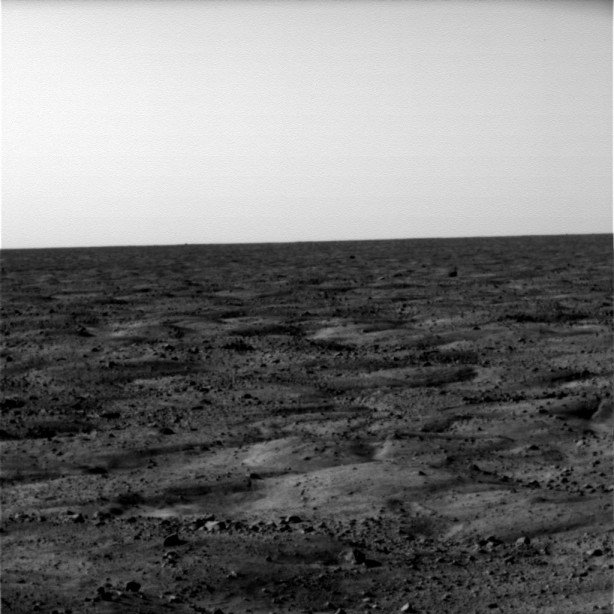
Image Credit NASA/JPL-Caltech/University of Arizona
The Phoenix lander has successfully touched down on Mars. The lander carries a CD which includes the names of my children.
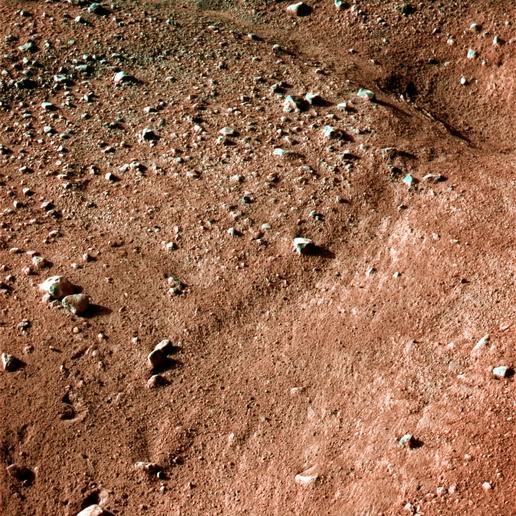
This was the first successful soft landing on Mars for 32 years. The lander has landed in really flat in a northern Arctic region called Vastitas Borealis. The Lander is also facing east-west as planned. The solar panels have successfully deployed, and the first images of the Martian North Pole have come back relayed through Mars Oddessy. It’s pretty featureless (well, that was the point, they wanted to land somewhere safe and flat). More images can be found at the Phoenix Gallery. So far there are lots of shots of the lander and the surrounding terrain. These are mostly black and white images mostly to confirm the lander is okay and everything is working. There are also some colour images.
When all instrument checks are completed the lander will extend its robotic arm and dig through the protective top soil layer to the water ice expected to be below. Both soil and water ice will be returned to the lander platform for analysis. Hopefully this information will provide insights into the following questions: can the Martian Arctic subsurface support life, what is the history of water at the landing site, and finally, how is the Martian climate affected by polar dynamics?
We will all be watching the Phoenix lander intently over the next 90 days.
Dude, you named your kids “command.com” and “autoexec.bat” just so you can tell them their names are encoded on the Mars mission’s lander? That’s taking things a bit far.
Who wouldn’t? If we would have ahd a girl, she would have been named “sys.ini” (And the boys would be yelling “hey Sys”).
Waitaminute! You mean the Phoenix Lander’s computer is a DOS machine? For a graphics-intensive mission, you would think they would have used Windows.
I don’t know what Phoenix uses, but a lot of recent space probes from the late 90’s/early 00’s used a rad-hard variant of the classic Motorola 68000 family. So maybe it’s running early Mac ;)
Actually, though I wouldn’t expect to find it on a space probe, DOS is still around, alive and kicking. I work with a lot of robotic motion-control equipment and DOS is still very common in new industrial applications. After 30 years, it’s uber stable and has an extremely predictable interrupt response (because there’s almost nothing going on in the background). It’s not a good thing for your PC to suddenly start asking questions about updating daylight savings time while a two thousand pound machine is in motion.
Not only that, but, believe it or not, the ISA bus is still alive in new machines! DOS/ISA is often the weapon of choice for non-graphics systems where the “blue screen of death” really could be the “blue screen of death”.
I hope it gets moving. The soil right under it has just been scorched. Both pictures show a pattern indicative of a freeze - thaw cycle of something (H2O? CO2?) sometime in the past.
Pete, this probe isn’t a rover. It is where it is, and where it will always be.
It’s also worth noting that although its mission is slated for 90 days, so were the missions of Spirit and Opportunity. They’re still going, 4 1/2 years later (though they’re beginning to really show their age).
Pete, DUH! Of course the lander isn’t a rover. It is a digger. Lou, the 90 time limit is pretty firm; the lander can not survive the Martian winter. In about 3 months, it will become dark and very cold. The solar cells will cease to function and the lander will probably be coated with dry ice. Ian, what’s with the CD? I don’t recall reading about it, and other craft, such as the Dawn probe, carry such data encoded in ROM chips. Are you sure about the CD?
How long before we hear that some Martian features are proof of recent (6,000 year old) creation?
Maybe evidence(s) against “Darwinism,” but in this age of “don’t ask, don’t tell” a YEC claiming that it supports a recent creation will probably be as rare as a Flat Earther claiming that the landing was faked.
Nevertheless I can vividly picture Ben Stein yawning: “Let me know when they land on Uranus.”
Oops, sorry about the spelling, George.
Um, yes, I too has heard NASA has upgraded to ROM name data. CDs are so clunky and massive 90’s.
The Planetary Society used an intermediary solution at times, letting a photo equipment calibration sticker carry CD encoded data on NASA missions. But I assume those have been surpassed by some smaller and lighter, possibly internal, calibration technology.
IIRC they suspect that the high latitude/low altitude area is an ancient sea bottom. Considering that the ground measures as perfectly flat, the lander reportedly has less than one quarter of degree slant, I would say that this hypothesis passed an important test.
And on some closeups one can see rocks moved outward by a blast pattern.
AFAIU the lander is equipped to handle that, it will scrape off a few centimeters of debris before starting to dig down in the possibly solid frozen ground. I assume one wouldn’t want those precious single use chemical kits to be contaminated by fuel burn residues.
Correction: I have heard that. I also don’t know if it applies to this mission specifically.
Torbjörn wrote
There are 22 analysis “kits” aboard Phoenix. At roughly 3-4 days per kit (which is what they estimate to be required from digging up a sample to finished analysis) they’ll be pushing the 90-day initial mission limit. At the press conference last night they raised the definite possibility of a 50 (60?) day extension if the engineering analyses say they’ll have enough watt-hours to do science.
I myself would “waste” one of those kits on a surface debris analysis to get a baseline for the deeper analyses. Test some debris one knows to be contaminated by the landing engines to get its chemical profile in order to ascertain when the contamination ends in the trench.
It’s actually a DVD. Here is an extract from the planetary societies email to my sons.
Drop in to the Planetary Societies Messages website to read more.
…which raises an interesting question: Is there a Flat Mars Society? Or is the Earth flat while other planetary bodies are spherical? Inquiring minds want to know.
Does Uranus even have land (i.e., a solid surface of some sort) on which something could conceivably land?
Henry
NASA’s Mars Reconnaissance Orbiter (MRO), currently in orbit around Mars, recorded an image of Pheonix in the upper atmosphere on its way down to land.
Image at:
http://nasawatch.com
a useful site if you are curious about NASA.
Oops the final descent was by parachute. You can watch!
“other planetary bodies”? What do you mean, “other planetary bodies”? The “planets” are windows into heaven. Didn’t you know that?
I understand that the parachute was dropped during the last part and thrusters were used to slow down the lander’s speed to around 5 mph
Yes
Didn’t you hear? Those are questions, like those about the age of life and common descent, that we shouldn’t bother with until ID defeats “natutalism.” So for now just be reassured that ID can accommodate a speherical or flat Mars. ;-)
These pictures are nothing more than photos of the Mojave Desert…Another skeptic debunking the absurd thinking that anything we are doing is adding anything to scientific thought
I confirm B. BOyd’s observation, since I, an atheist, was denied the right to buy a Ford at the very dealership shown in the original of this obviously photo-shopped picture of “Mars.”
I’m sure the evolutionists’ enjoy playing with their new billion-dollar toy the taxpayers have provided them to help them prove their religion by finding molecules evolving into life on Mars since they have been unable to find this on earth. Why can’t Christians on either side of the pond get the same money to prove the Bible is true? Their wanton waste of taxpayer dollars on their personal ego gratification will exhaust the patience of our Lord and Savior! The hubris of the evolutionists will outlast his longsuffering! I think he will make the International Space Station crash on Richard Dawkins during one of his speeches denouncing him!
Looks like they actually mounted some CDs to the top of the lander. New raw photos from the lander show a small stack of discs next to the US Flag. The top one is labeled “Messages from Earth 2007”.
Ah, I hadn’t taken the long time between analysis into account. Most kits are going to the Thermal and Evolved-Gas Analyzer, which may or may not take so long, depending on the profiling ramp. Haven’t been there, haven’t done that.
There is also an hawesome AFM tied to an optical microscope on one analyzing station, which would make for some serious play time as well. Time will likely be spent on microscopic analysis to prepare for the sample going to the next chemical kit. Thanks, RBH!
And it makes eminent sense in that case to examine the contamination issue instead of trying to avoid it.
1) Actually, over the millenia, a vast amount of time and treasure has been expended in an effort to “prove” the Bible.
At least in regards to the architectural and historical aspects at least, good research is still done very day.
However, in regards to creation, every single iota of evidence ever found has gone the other way. That hole has been drilled, again and again. It’s always dry.
2) Whose Bible? What holy books should be investigated at taxpayer expense? Should there be a federal agency for studying Mohammed’s night flight to the temple mount? For investigating which Hindu deity makes up the most creative use of mix-n-match body parts? Or how about a department investigating exactly which kinds of mind altering drugs go best with Dreamtime?
What about Buddhism? That might be the most fertile scientific ground of all, seeing as how meditation and a cultural ethos toward staying in shape actually have already been proven to confer significant returns.
Oh, wait, I get it - it’s just your Bible that you want to spend taxpayer money on.
Well, didn’t God instruct man to “Have dominion over all things”? I seem to recall that command being right up front onthe first page of Genesis, some of His first words spoken to man. Don’t you assume that God made Mars, just like he made all his creation, for the use of man? Doesn’t dominion imply enough exploration to at least investigate what’s going on up there?
If there is life up there it should be theologically no more bothersome than the explorers of the 1700’s finding life on every unknown Pacific island, or of Amundsen and Scott finding lichens in Antarctica. There’s no reason life shouldn’t be there, because God apparently likes to make living things.
God should be happy we’re finally running an inventory.
I fail to see the problem. Please, enlighten me, why should man using his God given intelligence and curiosity - the greatest gift ever bestowed - to investigate God’s extended creation - as instructed - make God sad?
I call “POE” on Joyboy!
@tiredofthesos - Did you write a “nasty gram” to the dealership? I did.
and OT: some of you might find this interesting.
Did a doubletake at the thumbnails of the Raw Image Mosaics at the bottom of the page (as of 27th May). Jings! they’ve found hominin calvaria ALREADY?
http://www.nasa.gov/mission_pages/p[…]n/index.html
They already have george:
http://www.answersingenesis.org/doc[…]ews.asp#ret1
Who knows? Let’s send Stein and find out. One-way.
I would imagine that it’s solid, given the low temperature. The reference was to Stein’s science teacher character in “The Wonder Years” where the class gets a kick out of his pronunciation (Ur-aaay-nus).
What could be better than promoting good science education, and having students appreciate the value of research?
Thousands of years from now when a technologically advanced civilization (re-)develops on Earth, they will begin to explore the Red Planet and locate strange machinery in several locations. It will be interpreted as proof of the veracity of their holy texts.
Uranus: Methane atmosphere, water ice, metallic hydrogen over a small rocky core.
And their hockey team sucks.
Uranus has a hockey team? :p
The question about whether or not Mars can support life has been answered. Apparently, Mars water is too salty to support life. -(I did a little blog about it last night)- From Science magazine … “Even the most salt-loving organisms of Earth couldn’t handle the most concentrated martian brines of 4 billion years ago
Personally I don’t think near enough exploration has been done on Mars for anyone to make that claim.
Well, didn’t God instruct man to “Have dominion over all things”?
Yes: including his gullibility.
I would agree on the question of life. This is just a (rather weak) data point at this time.
There is many locales for life unexplored, and as it seems rock weathering is what early organisms fed on on earth I would assume we would have to “dig deeper” to be certain.
And there are still those intriguing traces of methane and formaldehyde to explain fully by non-biochemical processes. I wouldn’t give up on the search until most every possible lead have been followed.
All the better to insist on verifiable proof before teaching ID in schools, Phil.
Ouch! LoL!
If you want to hear an audio file of the Phoenix landing - you can go here . It’s not terribly exciting, unless you are interested in that sort of thing.
OT: The pilot of the shuttle that just launched is named – wait for it – Ken Ham.
Phoenix may be sitting on ice - literarily. Seems those thrusters were good for something else anyway.
Btw, I’m not sure this is true. Apparently the paper will present water activity levels:
But the Dead Sea has lower water activity:
That paper presents three species of live fungi in Dead Sea water.
But another paper on the saltiest lake on Earth, lake Karum (aka lake Assal) in Ethiopia, not only found 164 different strains from 61 species of bacteria, but most (146 strains) were nonhalophilic! Of strictly freshwater strains they found 2, and of euryhaline strains 144. AFAIU euryhaline bacteria, bacteria living in a wide range of salinity, are “simply” able to adjust osmotic pressures, which confers resistance to various environmental stresses including drying. Seems like a trait Mars bug would like to have.
Tosca et al are more interested in the environment where life started of course. But they are also making claims on halophiles in that article:
Not exactly a clear line on whether cellular life is possible, and seemingly much too conservative about the need for specialist adaptation to the specific environment.
Update