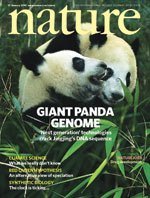
You humans have finally finished sequencing my genome—okay, not exactly mine but a cousin’s. Some of you might be thinking about using this to clone me. But I own the copyright to myself so you can’t do anything!
I’m busy clubbin’ with some seal friends of mine right now and haven’t had the time my species needs to digest such monumental work. I recommend Matthew Cobb’s take on the giant panda genome.
This comment has been moved to The Bathroom Wall.
“I’m busy clubbin’ with some seal friends of mine right now…”
We’re making seal-clubbing jokes now?
This comment has been moved to The Bathroom Wall.
ok joviality aside, I wonder if there is someone who knows enough about the method used to sequence this genome to be able to address some real questions i have:
1. Is the technique the chinese used repeatable, and if so, will we be seeing it used to even more rapidly sequence genomes in the future?
2. There are pitfalls mentioned wrt to what I will call “overscaffolding” which imply that certain gene patterns can be lost with this techinique. Could someone better describe exactly how this could occur, what the real impacts are, and if there is a way to mitigate this?
The headline clearly says “Giant Panda Genome”. Professor Steve Steve, have you looked at your self in a ruler lately?
This comment has been moved to The Bathroom Wall.
Well, now we can figure out how to give Steve Steve a real thumb.
This comment has been moved to The Bathroom Wall.
Didn’t someone say recently in another thread that the really big genomes belonged to some of the amoebae?
I’m afraid that’s unlikely to happen. It turns out that the Biologic Institute has been evaluating these results, and has obtained and “sequenced” some “DNA” from Prof. Steve Steve himself, without his knowledge. This is still unofficial, but I’m told that they have determined that Prof. Steve Steve is indeed “intelligently designed” but that other pandas are descended with modification from other species, just as some IDers have admitted that H. sapiens is. ;-)
Size doesn’t matter.
This comment has been moved to The Bathroom Wall.
I’ve worked with some short-read, deep sequencing (20x–30x) data and found it to be a big pain. Mapping and assembly error is a really big problem. Short-read sequencing might produce $1000 genomes, but it will come with $100,000 analysis.
This comment has been moved to The Bathroom Wall.
Size doesn’t matter. ;-}
This comment has been moved to The Bathroom Wall.
dammit reed! that was not there when I wrote that!
Thank-you, Reed!
dpr
I’ve worked with some short-read, deep sequencing (20x–30x) data and found it to be a big pain. Mapping and assembly error is a really big problem. Short-read sequencing might produce $1000 genomes, but it will come with $100,000 analysis.
so you think this will not become a widely accepted technique then?
or is it modifiable such as to be able curb a bit of the “jigsaw” aspect to it?
I don’t know enough about this technique to hazard a guess.
This comment has been moved to The Bathroom Wall.
The Panda’s Thumb (book) provides a layman’s evolutionary description of what the thumb is. I.e., a wrist spur.
But your question provides us with an opportunity to ask the creationists lurkers here a question. The TOE predicts that any “thumb” genes would actually be (e.g.) modified wrist genes, or modified genes for controlling the timing and tempo of bone growth in the hand.
But of course, modifying a wrist bone is a pretty crappy design for a thumb. So maybe I.D. predicts a different, more rational choice of genes for the panda’s thumb. What say you guys? Care make a prediction different from the TOE as to what the genetics for the panda’s thumb will be?
That’s not the giant panda genome, it’s the genome of the giant panda, right? There is a difference!
This comment has been moved to The Bathroom Wall.
IanW -
In many cases you would be right. For example, the “flag of Canada” is also the “Canadian flag”, but it is grammatically incorrect to refer to it, in English, as the “Canada flag”.
However, in the case of genome sequencing, the English language has adopted a different grammatical convention.
The noun form of the common name of the species, followed by the word “genome”, is accepted by convention. Hence “human genome”, “mouse genome”, and so on.
Therefore, in this context, you are incorrect. The genome of the giant panda is, in fact, correctly referred to as “the giant panda genome”. That is the English language convention, when referring to sequenced genomes, as established by prior use in the scientific literature.
So if I want to emphasize the large size of Prof. Steve Steve’s genome in the future, I’d better refer to it as the giant giant panda genome, right?
This comment has been moved to The Bathroom Wall.
Its how much bamboo you can eat
This comment has been moved to The Bathroom Wall.
Did anyone else catch Steve Steve’s cameo on CSI last Thursday? (1-21-10)
He played a bloody golf club cover.
Update