Independence Day bouquet – Alpine thistle, daisy chrysanthemum, button chrysanthemum, spray rose. Flowers courtesy of Sturtz and Copeland Florists and Garden Center, Boulder, Colorado.
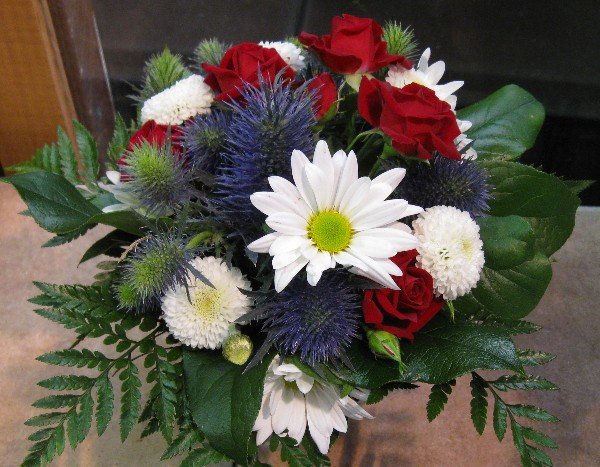
Independence Day bouquet
Categories:
Tags:
7 Comments
About this Entry
This page contains a single entry by Matt Young published on July 4, 2010 8:00 AM.
The God App was the previous entry in this blog.
Can radio waves harm trees? is the next entry in this blog.
Find recent content on the main index or look in the archives to find all content.
Categories
- Announcements (7)
- Assault on Science (455)
- Bathroom Wall (13)
- Book Reviews (71)
- Conferences (24)
- Darwin's Finches (1)
- Designoids (9)
- Education and Legal (148)
- Eugenics (1)
- Evolution (667)
- Evolution Education (13)
- Expelled (69)
- Flyers/Pamphlets (3)
- Humor (151)
- ID/Creationism (97)
- Icons (2)
- Journal Club (32)
- Legal Issues (131)
- Manufactroversy (14)
- Medicine and Evolution (21)
- Metatalk (97)
- MustRead (7)
- News Roundup (29)
- Origin of new genes and new information (3)
- Prebiotic Chemistry (8)
- Question of the Day (6)
- Question of the Moment
- Quote of the Day (14)
- Religion and Politics (14)
- Research News (62)
- Resources for Biologists (23)
- Shoptalk (29)
- Slightly Off Topic (79)
- Steve Steve (71)
- Sticky (3)
- Their Own Words (20)
- Theological Issues with Intelligent Design (12)
- War on Science (47)
- What motivates creationism (23)
As any gardener would note the problem is always to get a true blue. Oddly enough this also holds in the animal world where blue, at least in birds, comes from refraction of the surface of the feathers. Anyone know why ‘blue’ is so difficult?
I’m not quite sure what the implications of us true blue Democrats might be.
That’s curious. Blue occupies a healthy portion of the visible spectrum, and many insects can see into the ultraviolet, so you would expect a healthy reflectance in the blue portion of the spectrum. Maybe it is mixed with red or violet.
At any rate, you can always do it this way.
Mostly not refraction, I think, but interference from stratified feathers.
Happy birthday, neighbours. I hope I look as good when I’m 224.
Indeed with grackles, hummingbirds, and a number of other birds with rich, deep coloring, slight changes in the direction of bright sunlight makes the colors change.
Grackles look purple in some kinds of lighting and jet black in others. The ruby throated hummingbirds that come around our feeder change color even as they come in for a landing on the feeder. The flashing of their ruby bib appears to be a refractive effect.
No, it is red because of interference colors – think of Bragg reflection or multilayer films.
When I was in college, I heard a colloquium by the physicist who was apparently the first one to explain why the hummingbird was colored even though there was no pigment. All I remember clearly was his closing line: “I myself heff never seen one, but I know exectly why zey are colored.” At least, I think that’s how he sounded.
I just wish my blueberry bushes would start producing tons of blueberries.
oops. 234. Heh.
Update