Photograph by Pete Moulton.
Photography contest, Honorable Mention.
Dasymutilla_gloriosa – female thistledown velvet ant busily digging up the burrows of sand wasps along the bank of the Rio Salado north of Mesa. Mr. Moulton adds, “This isn’t an ant at all, but rather a wingless Mutillid wasp; and for all its cute fuzzy appearance, it’s reputed to be a ferocious stinger.”
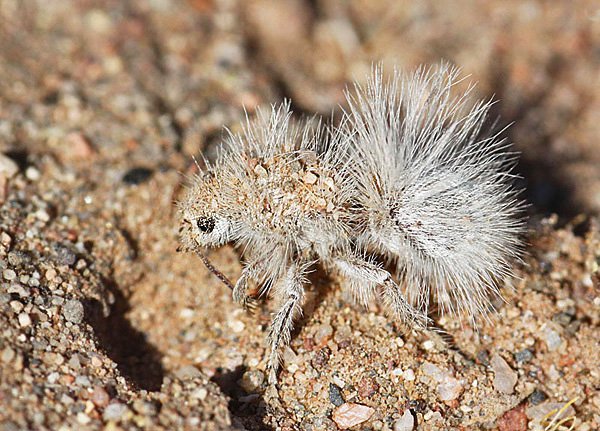
The Eastern velvet ants we have here in SC are beautiful, but I wouldn’t want to find one crawling up my leg. They may not actually kill cows (or even belong to the ant clade), but they did get the name “cow killer ant” for a reason. -Wheels
Looks like a mangy weasel.
Glen Davidson
It looks like a spider as well.
That’s gorgeous.
The species in California are sometimes called “mule killers” for that same reason.
Beautiful indeed, and I agree, its wingless nature makes it looking like a spider…
A
http://viewsontheworld.blog.com/
But then, ants apparently evolved from wasps. So while that no more makes it an ant than evolution of birds from dinosaurs makes a velociraptor into a bird, it does lessen the impact of saying that it’s not an ant, it’s a wasp. In one sense, an ant and this critter are both wasps.
Glen Davidson
Picky, picky, Glen! But you’re right. I probably could’ve worded that a bit more elegantly, eh?
Wasp or ant, it’s still a bug!!111!!!one!!!eleven!!!
No, velvet ants belong to Hymenoptera, not Heteroptera. {/pedantry}
In that case:
Wasp or ant, it’s still an insect!!111!!!one!!!eleven!!!
Henry
Update