Boavus idelmani – extinct species of boa, middle Eocene, western South America, 48.6-37.2 million years ago. Denver Museum of Nature and Science; cast by American Museum of Natural History FR 3850.
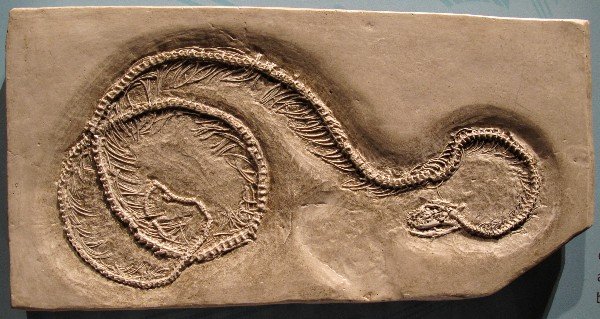
Boavus idelmani
Categories:
Tags:
19 Comments
About this Entry
This page contains a single entry by Matt Young published on September 17, 2012 12:00 PM.
The DI’s list of “Darwin doubters” analyzed was the previous entry in this blog.
An interactive brain atlas is the next entry in this blog.
Find recent content on the main index or look in the archives to find all content.
Categories
- Announcements (20)
- Assault on Science (482)
- Bathroom Wall (13)
- Book Reviews (79)
- Conferences (26)
- Darwin's Finches (2)
- Designoids (9)
- Education and Legal (182)
- Eugenics (4)
- Evolution (809)
- Evolution Education (33)
- Expelled (71)
- Flyers/Pamphlets (3)
- Humor (161)
- ID/Creationism (114)
- Icons (3)
- Journal Club (35)
- Lab Notes (1)
- Legal Issues (135)
- Manufactroversy (17)
- Medicine and Evolution (22)
- Metatalk (100)
- MustRead (7)
- News Roundup (31)
- Origin of new genes and new information (6)
- Prebiotic Chemistry (8)
- Question of the Day (6)
- Question of the Moment
- Quote of the Day (14)
- Religion and Politics (17)
- Research News (66)
- Resources for Biologists (24)
- Science and faith (2)
- Shoptalk (35)
- Slightly Off Topic (110)
- Steve Steve (71)
- Sticky (3)
- Their Own Words (22)
- Theological Issues with Intelligent Design (12)
- War on Science (53)
- What motivates creationism (25)
Aren’t fossils of Boavus restricted to the Eocene Green River fauna of Wyoming?
Doesn’t look a day over 30 million years old!
Glen Davidson
Is that the guy what offered some fruit to Eve?
It’s not wearing Nike sneakers–evolution is fake!
Actually Boas are constricted. Besides, can’t you see the well developed vocal cords? All the better to tempt you with an apple my dear.
Scale?
When alive, it had several, but in death, they all fell off.
Oh, wait, you meant size: according to Fossil Snakes of North America, one specimen of B. idelmani was about 37 and thirteen-sixteenths inches long stretched out in a straight line.
As a working hypothesis…probably not…SAG isn’t that old.
Using a micrometer to get the measurement being approximated?
Serpentine Actors Guild?
Sorry - should have recorded that! Even the Web is silent, but my recollection is that the plaque was no more than 30 or 40 cm across.
I haven’t the foggiest idea; the text was taken from the display, which I photographed. However, the AMNH says Wyoming or near Wyoming and gives a cryptic reference to the Green River. Unfortunately, they do not show a photograph nor mention the size of the object. Eocene is apparently correct, however.
There is a break in it’s bones I think that could be how it died. Picked up by a Pterodactyl then the snake bit it so it let go and the snake fell to the ground hitting a branch on the way down breaking it’s bones.
Wow Marilyn, I didn’t realise Pterodactyls flew so high! I make it that it took at least 15 million years for the dropped snake to hit the ground.
Didn’t somebody post a guide to the use of the apostrophe recently for the benefit of Mr Robert “Confirmation” Byers?
The primary problem with this hypothesis is that the strata Boavus found in have no trace of any pterosaur what so ever.
So then it’s possible that the spine lays over the top of it’s coiled body and the weight of the forming stone coursed the break, as in the other parts near the end of it’s body.
What an excellent fossilized specimen! Has anyone posted the fossilized mating turtles…? http://www.livescience.com/21056-an[…]fossils.html
Yes, what with the pressure and weight of several hundred tons’ worth of rock forming above it.
Nonsense - It’s where the Ark settled on him.
Update