Photograph by Marilyn Susek.
Mystery fossil – Ms. Susek’s father found this fossil in a coal mine in or near Sheffield, England. The rock itself is 7-1/2 cm long x 3 cm wide. I have sent the picture to several knowledgeable people and asked if they could identify the specimen; I received several authoritative answers, not all mutually exclusive. The response I consider most authoritative is – um, never mind; we will save that for later. Can any reader identify the fossil?
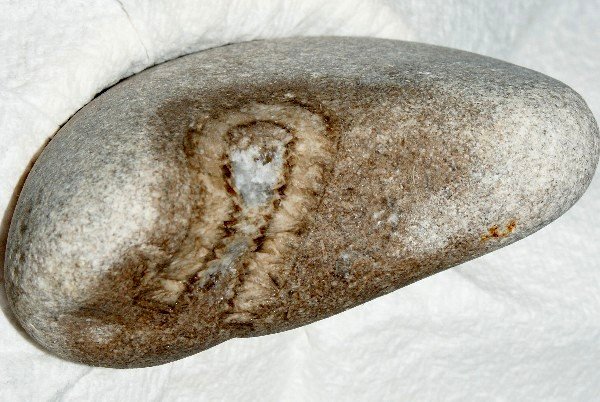
Looks a bit like the Virgin Mary.
Camptophyllia
Can’t be the Virgin Mary, it looks nothing like the stain on my shower door.
Is it indeed a fossil?
Maybe not.
Closer examination is required.
But what’s a well-rounded river or beach pebble doing in a coal mine? Seems exotic to me (in the geological sense). May be from the transgression or regression above or below the coal measure.
And has it been sprayed with acrylic lacquer to bring out the constrasts? Or is that oil or water on it?
You beat me to it.
Clearly this is an umbilical cord from a Unicorn.
It looks like dolomite with an igneous inclusion. The shiny stuff in the middle of the arch could be granite or other crystalline material.
That’s just based on looking at it.
A fossil doesn’t make a whole lot of sense from a coal mine. Coal usually forms very thick strata and don’t contain much in the way of non-organic rocks. Although, I’m not an expert. The Sheffield bed is partially exposed and between 290 and 350 million years old. It does overlay Permian limestone, so if the guy was at the bottom of the seam, he could be getting into Permian stuff.
If someone says for sure it’s a fossil, then my best guess would be a seed pod, probably of an extinct form of ginko.
Or something of Permian Age.
Whoops, I misread that. Sorry. The Sheffield coal is overLAIN by Permian rock. Still, I guess something could have fallen from the Permian into a mine shaft or something.
OK, last attempt. If it really is Devonian rock under the coal seam, then that could be a horn coral (Heliophyllum).
This is rather hard to identify from the poor photo, which is completely lacking a scale reference. A ruler (scale) would do much good, as would at least one close view.
Read more carefully.
Flat, eroded cross-sections are difficult to identify in any case, and photos are worse. The dimly visible structure in the fossil, if it is a fossil at all, suggests a graptolite, though I don’t know of any preserved that way, whatever it is. The shiny stuff in the middle looks to me like calcite. I’d be interested to know if the apparent dark stain is in some way associated withe the fossil, if it’s a fossil.
There is no scale reference in the PHOTO. Yes, vague dimensions are given in the text. Anyway, I think it looks somewhat like a rugose coral, but it is hard to tell. There used to be an expert around here who could definitively identify objects like this, no matter how bad the picture is. His name was Ed Corndog (or something) and he had a website called “man as dumb as coal” or something like it.
My two cent’s worth: Looks like a trace fossil of a tunnelling critter’s tunnel.
JUST LOOKING AT THE PICTURE, it looks like a rock that was lying for a long time under some rusting iron junk, taking on rust and maybe oil or other stains, thus making a “picture” of whatever was lying on top of it. There certainly could have been iron junk in a coal mine. As for the river cobble, it was obviously hydrologically dropped there by the Flood ;)
Piltdown Man’s stone tool?
There are things about this that make me think echinoderm – perhaps a crinoid stem, although the given scale/dimensions make this seem too large and less likely. I agree with Klaus that a reference scale in the picture should have been included. You really need to hold this in your hands and use a hand lens on it.
Rock measurements above but the fossil measures 7 cm long and 1/2 cm wide it is possible it didn’t come from inside the mine but I don’t know for sure.
Looks like an invagination.
The roundness of the rock, to me an artist, not a scientist, is indicative of water wear, and it could be one of those worm like sea creatures. If a hoax then it is a carving of an “R” as in Rolls Royce, by a kid, who decided to make all of us part of his prank
Oh and he/she was either making a mold or dyslexic
Is the dark area staining of a smooth pebble, or a sunken area that has been protected from the abrasive polishing that the rest of the pebble has been subject to?
Okay, using 7.5 cm as the long dimension,* I have determined the following. The tube-like portion of the specimen (near the bottom of the rock in the view we are given) is roughly 1.4 - 1.5 cm across. The bulbous portion of the specimen (near the top of the rock in the view) is roughly 1.8 - 2.0 cm across.
*The specimen’s given width of 3 cm is too short for the given length, assuming that dimension is correct. I used the given length to make my measurements for no reason other than I had to make a choice, and I did not want to devote any more time to this than I already have.
I am ready to hear the authoritative responses of the knowledgeable people you showed this to. These folks have actually held the specimen in their hands, which I am convinced one must do before rendering any kind of intelligent identification of this thing.
Cut the suspense and tell us already, please.
I have only circulated the photo. Ms. Susek has not found any experts to look at the actual specimen, so the photo is all we have to go by. I will write up the responses I have received when I get a chance.
Another interpretation from the little information available in the photo is that the rock is granite, and the “fossil” is an oddly shaped growth (replacing something else?) of some K-feldspar, perhaps microcline.
What *is* a river cobble doing in a coal mine, anyway?
OH come on. You’re killing me here.
Agreed, it could be the trace fossil of a worm burrow. First I thought it might be a worm or larva of some kind, but you’d have to see segmentation across the object - the one that is vaguely U-shaped. Or it could be what Ogremk5 said initially, namely, an igneous inclusion in dolomite that was later eroded down to this pebble which was subsequently buried within the organic debris of a Carboniferous-age forest before that debris became the coal deposit.
I agree with EJH. Permineralized (via calcite/dolomite) crinoid column segment.
I’m more inclined to go with Paul’s observation or John Harshman’s. (BTW John Harshman, I hope you understand now why that pebble was found in the coal deposit. It was probably eroded down to that pebble, and transported by water until it wound up in the Carboniferous forest, before that forest died and its organic debris altered diagenetically into the coal deposit.)
No, I don’t. It seems very unlikely for a product of high-energy transport to find itself in a coal swamp. I can’t see the paleoenvironments as compatible. And I still don’t know what kind of cobble (too big for a pebble) that thing is.
It can’t be a crinoid stem, by the way. They aren’t that flexible, and the fossil displays none of the proper annular structure, and there is no hole in the center. I have no idea what the nature of the preservation is here, or what plane through the organism we’re looking at. If it’s an organism at all.
Isn’t it time for Matt to give us more information?
It’s fossilized rope, probably part of the reins from Adam’s tame triceratops. I’m surprised there’s any left; after The Fall, those fire-breathing dinosaurs usually burned their bridles and reins in rebellion against Man. Those are the ones that weren’t allowed onto the Ark.
I stumbled upon your breathtaking inanity here:
http://davidsorensen.zenfolio.com/blog
You’re a decent photographer and some of your photographs resemble some taken by Frans Lanting, and Art Wolfe, among others. However, Frans Lanting recognizes that everything he photographs is the product of geological and biological evolution and has devoted part of his professional career providing visually arresting images which demonstrate both. But you are incorrect to assume that “design in nature” results in perfection, since there are too many instances where design has resulted in organismal features as imperfect sa the Panda’s Thumb. Moreover, there are many notable Christian scientists who accept the overwhelming scientific evidence for biological evolution and recognize that contemporary evolutionary theory - which includes the Darwin/Wallace Theory of Evolution via Natural Selection - represents our best current scientific explanation of it.
John Kwok
I suggest that the only known explanations for many of the complexities of life involve common descent with modification. (Scientific or otherwise; good or not so good.)
The best scientific explanations often involve natural selection, but there are other possible factors, some doing better than others, such as the neutral theory, or symbiosis, …
To invoke some agents (like “intelligent designers”) which are able and willing to do anything at all, even if that is true that they did it, does not even attempt to explain why they did this rather than something else.
No disagreement with you there, TomS. But Sorensen seems like, so many IDiots, hung up on the “design” aspect of Nature, not realizing that the history of life on Planet Earth is replete with so many ad hoc “solutions” like the Panda’s Thumb. As for the best current scientific explanation for it, you have no disagree with me there regarding potential alternatives - just as long as they are not James A. Shapiro’s ludicrous “Third Way” Neo-Lamarckian theory of evolution which he has been promoting in his book and in his Huffington Post blogs - though for now the scientific consensus is that the best possible existing scientific explanation is, as I noted yesterday, contemporary evolutionary theory with its “root” in the Darwin/Wallace Theory of Evolution via Natural Selection.
I find it amusing that the Sorenson video is on the same page with a forty part series entitled “Why people laugh at creationists”. Maybe they were trying to tell him something.
It’s also amusing - but also all too typical - that Sorensen is yet another “drive by” cretinist over here at PT.
Martin Whyte of the Department of Geography, University of Sheffield has sent us this analysis:
Professor Whyte has also agreed to examine the actual specimen if Ms. Susek brings it to him, so stand by.
Matt, thanks for finally confirming this. I spent more than a little time zooming in on the image and thinking about it, so I was pretty sure about it being a crinoid stem. Thank you (very much) as well for putting this thread to rest (one hopes). I am always amazed at how these discussions turn so easily down some crazy tangential rabbit’s hole.
Many apologies – I seem to have forgotten: Martin Whyte saw the fossil in the, um, flesh (sorry) a week or so ago and verified that it is a crinoid.
A crinoid? So, are we looking at a cast/infill of the stem?
After Matt had posted the account by Dr. Whyte I then went to see him. As Dr.Whyte examined the fossil he described how mud had settled at the bottom of the stem and has fossilized but further up the stem the centre has crystallized. I thought it was a long curved specimen possibly a worm because it has a real fleshy appearance but Dr. Whyte had patience till I finally realized the structure by comparing specimens he had of fossilized Crinoid really amazing.
Update