
Human and Chimpanzee: 15% or 1% Genetic Difference? How Creationism Misleads the Public

In academic circles, various figures are cited regarding the genetic similarity between humans and chimpanzees. Some studies estimate the differences to be around 1% to 5%, while others suggest they might be as high as 13% to 15% or more. Creationists claim that recent research has debunked the so-called “1% myth.” In doing so, they aim to cast doubt on the evolutionary relationship between humans and other primates, and accuse evolutionary biology of clinging to outdated dogmas. However, in order to make their argument persuasive, they deliberately omit crucial information. Casey Luskin of the evangelical think tank Discovery Institute even went so far as to crop a graphic published in the scientific journal Nature, intentionally removing key data.
Are Human and Chimpanzee Genes Really 99% Identical?
Few scientific discoveries have shaken humanity’s self-image as profoundly as Darwin’s insight that our origins lie within the animal kingdom. The idea that we are not uniquely created beings standing above nature, but instead share a common ancestry with chimpanzees, gorillas, and other primates, remains intellectually challenging for many. This notion is particularly unsettling for religious individuals who view humans as the “crown of creation.” The fear of losing a sense of human uniqueness runs deep.
The realization that only 1.2% of our genes differ from those of chimpanzees hit like a bombshell; our shared evolutionary history becomes unmistakably clear. It’s no surprise that evolution deniers—broadly speaking, creationists—who reject our ancestral roots in the animal world, constantly question, downplay, and attack this close genetic relationship, branding it the “1% myth.”
Recent studies, however, appear to support the creationist narrative. Some no longer report 95% or 99% genetic similarity, but instead present significantly lower numbers—sometimes as low as 85%.
A recent study published in the journal Nature (YOO et al., 2025) confirms this approximate figure. An international research team offers a comprehensive reassessment of the genomic similarity between humans, chimpanzees, and other primate species, based on complete genome sequencing and comparative analysis of multiple primate genomes. The study combines high-resolution sequencing technologies with advanced bioinformatic methods to systematically detect both point mutations and structural genomic differences. The result: the total genome-wide difference between humans and chimpanzees is between approximately 13.3% and 14.9%.
Creationism Claims Victory: The 1% Myth Has Been Debunked?
At first glance, the recent figures suggesting a greater genetic difference between humans and chimpanzees appear to represent a dramatic revision of earlier estimates—and they are eagerly embraced by opponents of evolution. In creationist circles, the claim that humans and chimpanzees differ by only 1% genetically is now regarded as outdated or disproven. This claim is used to argue against a close genetic relationship between the two species. For instance, BORGER alias TERBORG (2019) writes (translated into English by MN):
The data of the 21st century show that the genetic gap between humans and chimpanzees is far greater than previously assumed and popularized by the media. When the media still claim that there is only a 1–2% genetic difference between humans and chimpanzees, they are relying on outdated knowledge that falsely implies humans are merely highly evolved apes.
The topic is discussed with astonishing frequency and freaky redundancy by the evangelical U.S.-based Discovery Institute. Between May 20 and June 26, 2025, the conservative Christian think tank published no fewer than sixteen articles focused solely on this very issue, with particular emphasis on the aforementioned Nature study.
Casey Luskin, Associate Director of the Center for Science and Culture at the Discovery Institute, adds a noticeably moralistic tone to his critique of the “1% myth.” He writes:
For now, we can safely say that this latest study shows that the human and chimp genomes are at least 14.9 percent different. This means that the human and chimp genomes are at least a full order of magnitude more dissimilar than the public is typically told. … These are all groundbreaking findings — and it’s a shame that Nature would not report the data clearly and would make all of this so hard to find — using jargon that most non-experts won’t understand. Why did they do this?” (LUSKIN 2025)
Luskin expresses indignation that the figure showing the genomic similarities was “buried” deep in the supplementary materials of the study. He speculates that the “groundbreaking” nature of the findings may have motivated Nature to present them as opaquely as possible. After all, the implications are significant: they challenge the supposed uniqueness of humans and call the 1% myth into question.
But have these newer studies truly debunked the so-called 1% myth? Does a genetic difference of 15% really demand a re-evaluation of human origins? Or is creationism simply engaging in a game of obfuscation—cherry-picking half-truths while omitting crucial context and key information?
What Creationists Don’t Say
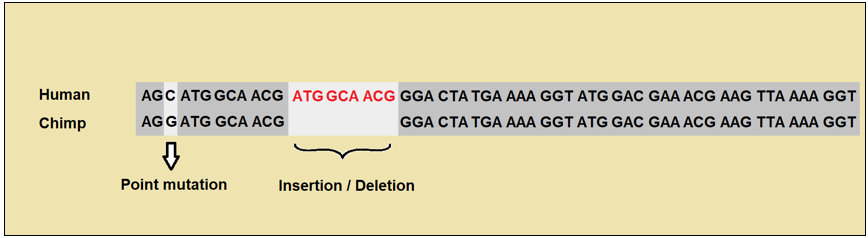
Despite the attention the recent Nature study by YOO et al. (2025) has received, the figure included in the appendix of the paper does not actually reveal novel insights. The reported 15% difference refers to the fact that only about 85% of the human and chimpanzee genomes can be aligned base by base—that is, with exact positional correspondence of DNA sequences (see Fig. 1).
The reason for this discrepancy lies in larger insertions and deletions within the genomes, known as InDels. These are stretches of DNA that have no direct counterpart in the other species’ genome—only gaps can be assigned in their place. Another factor is translocations, in which entire segments of chromosomes have shifted to new positions, disrupting the linear alignment between the two genomes. These changes are the result of chromosomal mutations, which can affect dozens or even thousands of DNA bases at once.
Extended repeats—DNA base sequences (nucleotides) that occur multiple times consecutively in the genome—can also disrupt sequence alignment. These repeats can arise and expand due to errors during DNA replication (known as replication slippage) and mistakes in DNA repair. Mobile genetic elements, such as transposons, also contribute to the accumulation of repetitive sequences.
Transposable elements account for approximately 45% of the human genome, making them extremely common. Way above 90% of these elements have no function (MORAN 2023). They are predominantly found in non-coding regions, where they are less subject to negative selection. As a result, they have accumulated relatively freely over the course of evolution. These elements often affect larger segments of DNA at once, are highly dynamic, and show considerable variation even within a single species. For these reasons, the gaps they cause in sequence alignments are generally not counted as individual nucleotide differences when assessing genetic similarity between species. Since such events usually affect entire blocks of nucleotides, each gap is typically counted as a single difference.
Tandem repeats are generally excluded from genome comparisons because their length is highly variable—even between closely related individuals. For example, every person carries several thousand more differences in the tandem repeat regions of their genome than their parents. While this high variability makes tandem repeats useful for fine-scale analyses of genetic relatedness, they are unsuitable for comparing entire species. Similarly, low-complexity regions (LCRs) are often ignored in genome comparisons. These regions can distort sequence alignments and lead to spurious homologies that do not reflect true evolutionary relationships.
In short, contrary to creationist claims, the established methods for measuring genetic similarity—such as applying special rules for handling gaps—are well-founded and purposeful. These approaches are designed to account for the biological realities of genome structure and evolution. By selectively excluding certain sequence features (like tandem repeats or low-complexity regions), scientists aim to avoid misleading results and ensure that genetic comparisons accurately reflect evolutionary relationships.
The crucial point is this: In those regions where a direct comparison is possible and purposeful, analyses have consistently shown, for decades, a genetic similarity between humans and chimpanzees of 95 to 99%. The exact figure depends on which parts of the genome are being compared—whether coding regions (which produce proteins), introns (non-coding regions within genes), or intergenic regions (the DNA between genes). These values have been consistently confirmed by more recent scientific literature.
For example, KRONENBERG et al. (2018) divided the genomes of various primates into segments of one million bases each. They then examined the differences among these segments at the level of single nucleotide variants (SNVs)—that is, single-base changes. For each segment, they calculated how many of these SNVs differed from the human genome. The result: 1.27% of the DNA bases differ between humans and chimpanzees. For humans and gorillas, the difference is 1.61%, and for humans and orangutans, it rises to 3.12%.
Similarly, SUNTSOVA & BUZDIN (2020) found that human-specific single-nucleotide changes account for approximately 1.23% of the human genome, while larger insertions and deletions (InDels) account for about 3%.
Large Differences in Gene Regulation, Small Evolutionary Distance
TERBORG (2019), writing from a creationist perspective, emphasizes that the differences between humans and chimpanzees are much greater at the level of gene regulation. According to him, it is not primarily the protein-coding genes that determine an organism’s characteristics, but rather the promoter regions of homologous genes (the “gene switches”) and regulatory elements such as miRNAs and HAR transcripts (human accelerated regions).
However, ironically, it is in the brain—arguably the most complex and uniquely human organ—where gene expression differences between humans and chimpanzees are particularly minimal, as shown by KHAITOVICH et al. (2005).
Moreover, larger differences in gene regulation do not negate the close genetic relationship or the evolutionary proximity between the species. A single mutation in a cis-regulatory element, or the duplication or variation of a miRNA gene can alter the activity of many genes at once. That regulatory divergence can result in significant phenotypic changes—without a corresponding increase in the number of actual mutational events.
As explained in Fig. 1, it is not regulatory effects that count when determining evolutionary distances but mutation events. That is why the oft-cited 1.2% difference remains the decisive metric. A single chromosomal mutation may impact thousands of base pairs, but it still counts as one event. It therefore makes little sense to claim “thousands of differences” when referring to what, in evolutionary terms, is one mutation.
Only when every base in a gap (alignment gap) is counted as a separate difference does one arrive at figures like 15%. This clearly illustrates how misleading creationist presentations can be. By pitting different measurement methods against one another, they create the impression that an earlier scientific claim (e.g., 99% similarity) has been disproven by more recent data (e.g., 85% similarity).
This narrative is simply false.
Up to 13.8% Genetic Difference – Within Gorillas Alone
One key point creationists usually fail to mention: if you compare the genomes of different primate species and count every base, including those in alignment gaps, not only do the genome-wide differences between humans and chimpanzees increase—but so do the differences within a single species.
According to YOO et al. (2025), chimpanzees exhibit a genetic diversity of 8.8% within their own species. Even more striking: gorilla genomes differ from one another by up to 13.8%—within the same species!
Even worse: If you consider only the gap divergence (without SNV differences), as is the case in the Nature paper, you end up with a 13.3% difference between chimps and humans—which is actually lower than the genetic variability found in gorillas!
Given that such vast diversity can exist within a species, the 15% difference between humans and chimpanzees is not only unsurprising—it is entirely expected, especially considering that their evolutionary lineages diverged roughly 7 million years ago.
In fact, the genetic difference between chimpanzees and gorillas—both of which are considered “apes”—exceeds the 15% difference between humans and chimpanzees.
These findings are evidently so inconvenient for creationists that they are not just ignored or omitted, but—as Daniel Stern Cardinale demonstrates in a YouTube video (https://www.youtube.com/watch?v=VNs_lgWM6R8)— are intentionally obscured by LUSKIN (2025) (see Fig. 2).
Do the Ends Justify the Means?
Luskin presents a figure from YOO et al. (2025) that illustrates the degree of genomic difference between humans and other primates. The figure counts each nucleotide within gaps as a separate difference. However, when one compares the image he shows with the original publication, a striking omission becomes immediately apparent: Luskin displays only the upper portion of the figure, which highlights the genetic differences between species.
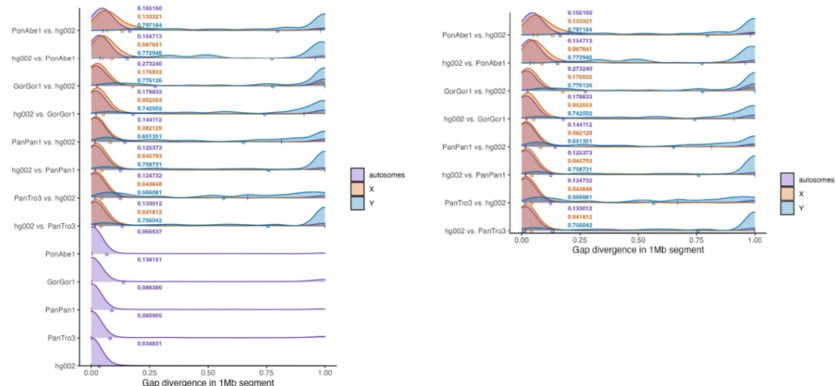
The lower portion of the graphic—depicting intraspecific genetic variation—has been deliberately cropped out (see Fig. 2). The exposure of this tactic is revealing for two key reasons:
First, the complete presentation of the data fundamentally undermines the creationist argument. If the gap divergence—within chimpanzees already amount to nearly 9%, and within gorillas to 14%, then the 13.3% difference between humans and chimpanzees suddenly appears remarkably small by comparison—unless the Discovery Institute seriously wants to claim that gorillas do not share a common ancestor.
Luskin was able to advance his argument only by withholding this crucial piece of information from his readers. 1
Second, Luskin calls into question the integrity of evolutionary biology. He accuses the editors of the journal Nature of deliberately hiding the “groundbreaking” findings deep within the supplementary material—implying manipulative intent. Yet, the opposite is true: the data are neither new nor revolutionary, nor do they constitute the central focus of the cited study. Luskin’s own manipulation of figures to obscure critical information lends an almost ironic twist to his critique. While his defense of purported higher truths may motivate the actions of this “design” advocate, the question remains whether the ends ever justify the means. ii
Summary
Depending on the method of comparison, the genetic difference between humans and chimpanzees is approximately 1.2% or around 15%. Evolution deniers deliberately emphasize the higher figure to portray the so-called “1% myth” as debunked. In doing so, they cast doubt on the genetic closeness between humans and other primates, and accuse evolutionary biology of clinging to outdated concepts. However, they overlook that the higher figure is based on a different methodology, which does not diminish the significance of the 1.2% estimate in any way.
What is even more troubling is their silence on the fact that this altered comparative approach also dramatically increases the measured genetic differences within primate species. For example, a recent study published in Nature (YOO et al. 2025) reveals that, by the same method, the gorilla genome exhibits up to 14% variation within the species, and chimpanzees up to 9%. Against this backdrop, nothing has changed regarding the close genetic relationship between humans and chimpanzees.
To obscure this fact, the Discovery Institute removed crucial data from a figure—showing a clear intention to deceive the public.
References
KHAITOVICH, P.; HELLMANN, I.; ENARD, W. et al. (2005). Parallel patterns of evolution in the genomes and transcriptomes of humans and chimpanzees. Science 309, 1850–1854.
KRONENBERG, Z. N.; FIDDES, I. T.; GORDON, D. et al. (2018). High-resolution comparative analysis of great ape genomes. Science 360: eaar6343.
LUSKIN, C. (2025). Fact check: New “complete” chimp genome shows 14.9 percent difference from human genome. Available at: https://evolutionnews.org/2025/05/fact-check-new-complete-chimp-genome-shows-14-9-percent-difference-from-human-genome [Accessed 07 July 2025].
MORAN, L. (2023). What is in your genome? 90 % of your genome is junk. Aevo UTP.
SUNTSOVA, M. V. & BUZDIN, A. A. (2020). Differences between human and chimpanzee genomes and their implications in gene expression, protein functions and biochemical properties of the two species. BMC Genomics 21: 535.
TERBORG, P. (2019). The genome of humans and chimpanzees: How close is the genetic relationship really? Studium Integrale Journal 26, 4–10.
YOO, D.; RHIE, A.; HEBBAR, P. et al. (2025). Complete sequencing of ape genomes. Nature 641, 401–418.
i Luskin (2025) has since replaced the cropped image with the original version. In an addendum, he explains that the earlier omission was merely for the sake of “simplification purposes,” arguing that “intraspecific genetic differences” are “irrelevant” to his point. He writes: “My argument is not that human-ape genetic differences necessary [sic] refute evolution; it’s that evolutionists who for decades have claimed humans are only 1 percent genetically different from apes were wrong.” In my view, this addendum fails to conceal either Luskin’s intent to manipulate or the flaws of his reasoning. Why?
First, he simply repeats the false claim that the 1% difference has been disproven. Second, the substantial intraspecific genetic variation in chimps and gorillas undermines the supposed “groundbreaking finding” of the 15% difference between humans and chimpanzees. This figure is neither “radical” nor does it carry meaningful “implications for human exceptionalism.” On the contrary, it aligns perfectly with what one would expect from an evolutionary perspective, considering that genetic diversity—when counting every base in the alignment gaps—reaches 9% in chimpanzees and 14% in gorillas. That alone discredits Luskin’s impertinent insinuation that evolutionary scientists had a motive to present their own data in a deliberately obscure way.
Luskin thus had every reason to conceal this additional information and crop the figure. His justification of “simplification” rings hollow.
Third, his strong emphasis on the 15% difference clearly serves a rhetorical purpose: to cast doubt on the scientific consensus that humans are highly evolved apes. If this were not the underlying goal, the degree of genetic similarity between humans and chimpanzees would not be such a persistent point of contention for the Discovery Institute. The claim that this is not about challenging common ancestry (“refute evolution,” in his own words) is, quite plainly, a smokescreen.
However, as Cardinale convincingly demonstrates in this YouTube video, this addendum can conceal neither Luskin’s manipulative intent nor the flaws in his reasoning.
ii Unfortunately, this strategy is not an isolated case: In order to falsely accuse the anthropologist Owen Lovejoy of having manipulated a fossil, the Discovery Institute cut and edited a video documentary in a highly misleading way to serve their propagandistic aims. Crucial segments, including an audio track that explained Lovejoy’s methodology, were deliberately omitted. For a detailed account of this remarkable case, see this YouTube-Video of Dave Farina (Min. 8:40): https://www.youtube.com/watch?v=HRxq1Vrf_Js
Machine-translated and edited by the author from the original German, and lightly edited and formatted by Matt Young.