
Building Bridges That Can Bear Scientific Scrutiny
Jamie Jensen is a biologist and discipline-based education researcher at Brigham Young University, where she is a Professor of Biology. She has spent her career researching ways to help students and the public reconcile science with religious worldviews and has done work across the U.S., with the Smithsonian, and in other parts of the world including Qatar, South Africa, and Hungary.
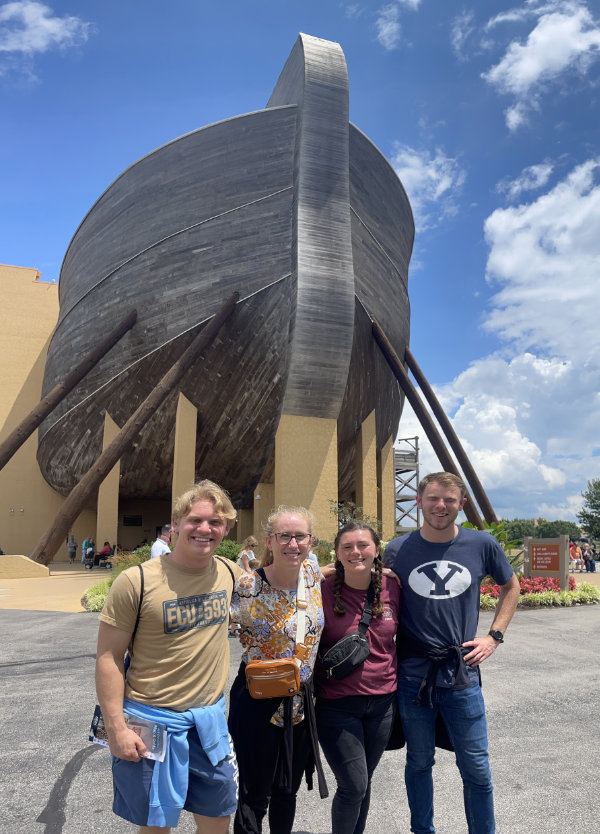
I recently had the “opportunity” to visit the “Ark Encounter” and “Creation Museum” attractions in Kentucky while visiting Vanderbilt University for the Scopes Centennial Celebration. After participating in the academic meeting, I took a group of undergraduate students with me to these two attractions; these students work in my research lab investigating ways to communicate accurate evolutionary science across religious divides. We have had quite a bit of success in our efforts to increase evolution acceptance in the classroom without damaging students’ religious identities (see here, here, and here). However, with some of my more public-focused programming, I have met with varying levels of resistance (and sometimes hostility), even from members of my own Christian religious “in-group.” (Yes, I do belong to a conservative Christian religion. And I also fully embrace the modern science of evolution, in its entirety.)
We went to these two attractions seeking to better understand the viewpoints of those who stand in opposition to evolution, and to characterize the misconceptions and logical fallacies that may stand in the way of effective communication across the divide. We were astonished at the extent and sophistication of the attempts made to “create” science that supports alternative worldviews. This is not a case of trying to “sweep under the rug” the inconsistencies between a biblical account of creation and the physical evidence we see around us. It was, rather, an elaborate attempt to build a pseudoscientific “reality” that would satisfy a not unintelligent, but not scientifically well-versed patron of the attraction. But as I walked the halls of this misguided attraction, I got to thinking:
What occurred to me is that people want a bridge. They want the science and their faith to make sense.
Gone are the days when parents could simply shield their kids from the science and hope they never encounter anything that questions their faith. Gone are the days when you could supply an alternative, completely non–science-based narrative and hope that your children never encounter the “real” story. With the advent of technology, social media, and information literally at our very fingertips, no one runs the risk of never being “exposed” to real science. And I think that those opposing evolution know this. They know that they can’t simply avoid the science. They can’t ask their patrons to rely on biblical writings alone. They can’t ask people to ignore the very real and very compelling evidence. They must invent a new science that is “close enough” to pass muster amongst their audience. They must build a bridge that, if crossed, maintains the integrity of their faith identity, and they understand that this bridge cannot utilize real science. But does this bridge have to be built on false scientific principles? I would argue that it does not.
But first: People want a bridge. How do I know? I have been gathering empirical evidence that suggests it. In our research lab, we have been studying what we call the “Reconciliation Model” for years in various settings with a variety of religious affiliations. The Reconciliation Model involves discussing the nature and limitations of science, offering alternatives to literal biblical interpretations, and presenting evolutionary content in a way that is friendly to faith. See here for some example lesson plans, from a variety of faith traditions. We have found that we can increase students’ acceptance of evolutionary theory without reducing their religiosity (e.g., here, and here. However, in a recent study, we noticed an enigma that got us thinking about this increase in acceptance a little more. In this study, we measured the relationship between a literal interpretation of the Bible and acceptance of evolution. In a nationwide sample, we see an inverse relationship: the higher your literalism, the lower your acceptance. In our classroom study, utilizing the Reconciliation Model, we found that we could decrease biblical literalism and thereby directly predict increases in acceptance. However, what was puzzling to us was that students’ biblical literalism remained high, even though they were experiencing dramatic upward shifts in evolution acceptance (especially macro- and human evolution). This finding launched us into a second study, which has not yet been published. But I’ll give you a sneak preview.
We re-surveyed students from among our highly religious student body and found students who were answering questions in a seemingly contradictory way. For example, they strongly agreed with both “Present animal diversity can be explained by the Great Flood” (a literal biblical interpretation) and “I think all complex organisms evolved from single celled organisms” (an evolutionarily accurate statement). We wondered how a single student could strongly agree with both statements at the same time. Through thematic analysis using cultural border crossing and collateral learning theories (Aikenhead 1999) as our a priori framework and then looking for emergent themes, we discovered two different lenses through which students were looking at these statements. Through an epistemological lens (i.e., “how do I know what I know?”), students felt certain that both science and religion are in harmony, that they could reconcile the two, that they could successfully build a bridge spanning the gap. For example, one student stated, “It doesn’t really feel important to me [to figure out how evolution and my religious beliefs fit together]. I just know that they do fit together. In whichever way it may be, I just know that they do.” Clearly, this student wants to believe that bridging the gap is possible – they want a bridge.
But, from a factual lens (i.e., “how does it actually work?”), students revealed a broad array of misconceptions, mental gymnastics, and uncertainty. When asked how the creation story in the Bible and evolution go together, this same student, who above was confident that both science and religion fit together, offered this explanation: “Just like… a lot of it like first starts off with the creation and all the species that were made and then when species start evolving and adapting to environments, that’s when more diversity happens,” indicating that all the “species” were created, and then they evolved to be more diverse. Another student, who stated from an epistemological standpoint, “I figured all truth is godly—whether it’s scientific or religious—they can be together,” then stated, when asked how the “Noah’s ark” story in the Bible and the evolution of modern diversity fit together, “I would have imagined that all of the land vertebrates that existed before the Ark would have died in the flood. So, the only ones that would survive would have been on the Ark…. But then there’s also that other part where maybe we’ve had some that have since come out of the water and they evolved that way.” Clearly, she holds misconceptions about the amount of modern diversity that exists, and about the time it takes to evolve from a water-dwelling organism to the diversity we see on land today (certainly more than the 4000 years or so since the flood supposedly occurred). We labeled these attempts to mesh a literal biblical interpretation and a scientific explanation together as “mental gymnastics,” which would be a new form of “dependent collateral learning” in collateral learning theory.
It is clear, from our work, that students can appear to be epistemologically secured (i.e., they want a bridge to be possible), when in reality, the bridge that they have built is full of factual holes and is likely to crumble as they obtain more information.
So, second: How do we help students build a bridge on a solid scientific foundation? And is it always possible? To answer the second part of the question first: in some cases, with extreme biblical literalist beliefs or specifically contradictory doctrine, a bridge may not be possible. However, in cases where this direct contradiction does not exist, I believe that it is possible to fortify their bridge. Here would be my advice: (a) Facilitate an accurate understanding of the nature and limitations of science. Research clearly shows that an understanding of the nature of science is one of the largest predictors of evolution acceptance (Dunk et al. 2019 provides a good overview). We have had large success in our courses when we emphasize the agnostic nature of science. Science can no more provide evidence for God (a theistic perspective) as it can provide evidence against the existence of a god (an atheistic perspective). Therefore, science is clearly agnostic and should not be a threat to anyone’s belief system.
(b) Do not shy away from the facts. There is an emergingly clear relationship between the knowledge of evolution and its acceptance (again, see Dunk et al., 2019). A lack of the basics of evolution is often a struggle for students trying to build bridges. Some of those big ideas include that evolution is not a quest for perfection, that speciation takes a really long time (longer than a human lifespan, usually), that organisms do not “choose” to adapt but that random mutations provide the variation upon which natural selection acts, that the process that leads to microevolution is the same process that leads to macroevolution, and that humans did not “come from” monkeys (i.e., an understanding of basic phylogeny principles).
I would caution though, to always keep in mind that only teaching the facts is not likely to overcome ideological barriers. Thus, (c) strive to use culturally competent strategies (or what is often now referred to as “conflict-reducing” strategies [Barnes and Brownell 2018]). Some of these strategies include acknowledging the potential for conflict, emphasizing the agnostic nature of science, providing religious role models who accept evolution, offering ways to reconcile science with religion, and practicing intellectual humility.
This is certainly a complex issue, and there is no one “silver bullet” way to solve these problems. Much of the conflict that exists today is the fruits of a long and troubled past involving historical events, impassioned publicity, and bad actors on both sides of the aisle. But we are not doomed to perpetuate the conflict. The understanding we have gained through rigorous research on pedagogy and communication can be used to launch us on a better trajectory to greater scientific literacy, more productive conversation, and more fortified bridges.
References.
Aikenhead, G. S., and Jegede, O. J., 1999. Cross-cultural science education: A cognitive explanation of a cultural phenomenon, Journal of Research in Science Teaching, 36, 269-287.
Dunk, R. D. P., et al., 2019. Evolution education is a complex landscape. Nat. Ecol. Evol. 3(3):327-329. doi: 10.1038/s41559-019-0802-9. PMID: 30718854.
M. Elizabeth Barnes and Sara E. Brownell, 2018. A Call to Use Cultural Competence When Teaching Evolution to Religious College Students: Introducing Religious Cultural Competence in Evolution Education (ReCCEE). Life sciences education, published online, https://doi.org/10.1187/cbe.17-04-0062