
Darwin Comes to Town: a meditation
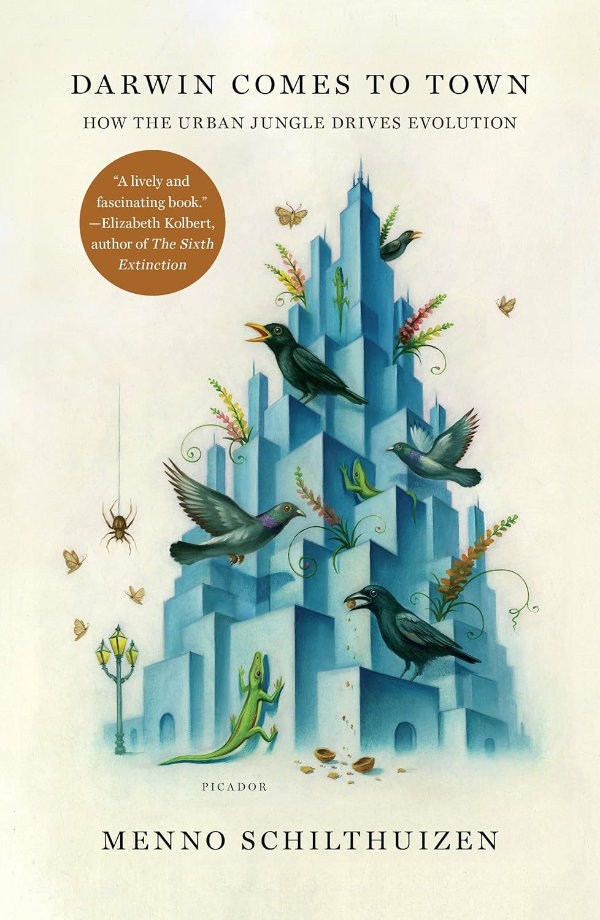
I recently came across this fascinating book, Darwin Comes to Town: How the Urban Jungle Drives Evolution, by the biologist Menno Schilthuizen of the Naturalis Biodiversity Center and the University of Leiden. Years ago, probably about when it appeared in 2001, I read Prof. Schilthuizen’s equally fascinating book, Frogs, Flies, and Dandelions, about the origins and definitions of species (indeed, the difficulty of defining species at all). So naturally I snapped up Darwin Comes to Town. The title is a pun, in that the book is about the evolution of organisms that have either adapted to cities or towns, or have adopted cities or towns. I will not review the book, but will pen 3 or 4 paragraphs about chapters that for one reason or another especially interested me. If you want more, read the book!
The first organism that Schilthuizen describes in detail is a Culex molestus mosquito that he discovers in the London Underground. Outside the Underground, evidently the mosquito feeds on birds, has an interesting sex life that involves large swarms, and also hibernates. Inside the Underground, it has learned to feed on humans, “seek [its] sexual pleasures in confined spaces,” and not hibernate. Its genes spread from city to city, presumably by plane, train, or car, and it interbreeds with its above-ground relatives. All this happened, Schilthuizen assures us, very recently, probably only since humans began digging tunnels.
As I was still reading the book, I came across a very short article in a Science magazine newsletter, Cultivating a pest, by Corinne Simonti. A paper by Yuki Haba et al. recently reported that, contrary to what Schilthuizen has written, these mosquitoes, which they call Culex pipiens form molestus, have a much longer association with us humans, and probably date back to the ancient Middle East. As I was reading these references, I cattily wondered how a biblical literalist, for example, would have responded if such a well-established “fact” had been disestablished.
Some time ago, in 2005, I became something of a minor expert on the peppered moth and posted an article, Moonshine: Why the Peppered Moth Remains an Icon of Evolution, with my colleague Ian Musgrave (who deserves all the credit for the Moonshine title; you may have to read the article to learn why). A short chapter, Urban Myths, told the story of the peppered moth clearly and concisely, including the “controversy” instigated by the journalist Judith Hooper. Hooper’s book, Of Moths and Men: An Evolutionary Tale, was, in Schilthuizen’s words, well-researched, but then without evidence she accused an important moth researcher, Bernard Kettlewell, of fraud. Musgrave and I took up her claims and showed that Hooper did not understand the vagaries of fieldwork in biology and almost without doubt Kettlewell had not committed fraud. Unfortunately, our paper was not published in a technical journal (I frankly do not remember why not), and Schilthuizen was unaware of it; I thought perhaps he might otherwise have been harder on Hooper. (Incidentally, for a discussion of creationists’ response to the case of the peppered moth, see the article by Paul Braterman, here.)
There is lots more in this book, but I want to get to the last part, where Schilthuizen discusses exotic or non-native species. He suggests, frankly, that they are here to stay and that eventually all cities will have very similar floras and faunas because they are intertwined by modern transportation. This contention leads him to the conclusion, which many will find contentious, that we might as well give in, embrace non-native species and even plant them when it seems appropriate. As a person who passionately hates field bindweed (Convolvulus arvensis), I will be curious to know what others think of his proposal.
And, of course, reader’s last inch: I thought the book was uncommonly well written and used anecdotes such as his own interactions with the experts to great advantage. Not once that I recall was I bored or thought he should get on to the next topic already.
Finally, Prof. Schilthuizen recommended to me his latest book, The Urban Naturalist: How to Make the City Your Scientific Playground, which was published last April and is sort of a sequel. You may be sure that it is on my list.