
Interstellar Comets: Creationism's Missed Opportunity?
![[Image of 3I/Atlas]](/uploads/2025/3I-ATLASa.png)
Multi-Object Spectrograph (GMOS) on Gemini South at Cerro Pachón
in Chile. From Wikimedia CC 4.0
On November 29, Answers In Genesis apologist and astronomer Danny Faulkner posted an article on the interstellar comet 3I/ATLAS. Dr. Faulkner’s article sensibly dismissed popular speculation (including persistent claims by Harvard professor Avi Loeb) that 3I/ATLAS and similar objects might be artificial probes or alien artifacts. But in doing so, Faulkner never addressed the only question that is cosmologically relevant for a young-earth framework: Where did this object come from? Interstellar comets are not curiosities or distractions; they are kinematic probes: natural test cases for any model purporting that the universe is only a few thousand years old.
For an organization that claims to be able to give “Answers” about what they call “origin science”, Answers In Genesis is suspiciously quiet about the origins of interstellar comets.
The Third Interstellar Comet
Ever since the rise of wide-field astronomical surveys, astronomers have kept a vigilant watch on the skies for near-Earth objects (NEOs): asteroids and comets whose orbits may bring them close to the Earth, with potential risk of impact. But beyond planetary defense, surveys also catalog a broad variety of small bodies because these minor objects carry clues about the formation and evolution of planetary systems: their orbits, compositions, and dynamics help scientists trace back when and how they formed, and how stable their source systems remain.
Comets in our solar system come in different flavors. Short-period comets have orbits closely bound to the Sun, often returning every few years or decades, typically originating in the Kuiper Belt or closer. Long-period comets have highly elongated but still bound orbits, often taking thousands or millions of years to complete (usually thought to arise in the distant Oort Cloud). Both of these types remain gravitationally bound to the Sun, albeit with very different orbital periods. A third, much rarer category — hyperbolic or interstellar comets — follows an unbound trajectory. Their eccentricity exceeds 1, placing them on a one-time pass through the Solar System: they arrive from interstellar space, swing past the Sun, and then depart forever.
In 2025, the world encountered only the third such confirmed interstellar visitor. The first was 1I/ʻOumuamua, discovered in October 2017, followed by 2I/Borisov, announced in August 2019. The newest, 3I/ATLAS, officially designated C/2025 N1 (ATLAS), was discovered this July by the Asteroid Terrestrial-impact Last Alert System (ATLAS) telescope in Chile. Follow-up observations soon confirmed its extremely hyperbolic orbit. Because 3I/ATLAS is active (i.e., showing a fuzzy coma and dust tail, like a “normal” comet) astronomers treat it as a genuine cometary body, not a rocky asteroid.
Faulkner’s Cosmological Commitments
Dr. Danny Faulkner has become the predominant AIG author and speaker on issues of astronomy since the departure of Dr. Jason Lisle some years ago, writing on topics ranging from light-travel-time and starlight problems to extrasolar planets, dark matter and dark energy, planetary system formation, and the operation of modern astronomical instruments like the James Webb Space Telescope. Over the years, he has articulated a reasonably consistent set of commitments in his elucidation of a “Biblical” cosmology. In defense of a recent special creation, he has argued that divine creation is characterized by stability and order, even using this perceived order as evidence for divine design.
Just two years ago, while explaining the evidence for dark matter, Faulkner wrote:
Creationists have long advanced the idea that there is design and stability in the world. For instance, some creationists speak about the stability of both planetary orbits and the orbits of the planets’ natural satellites, and even the stability of systems beyond the solar system. Which is it? Did God create a stable world, or did He create an unstable world? Are creationists willing to sacrifice the stability argument in favor of a lesser argument for relatively recent origin?
Science progresses only when we change and develop our models as new data are found. Rather than ignoring or denying the data that are invoked in support of dark matter and dark energy, recent creationists must produce their own models to interpret this data. Only through this difficult process can significant progress be made in achieving a robust, truly biblical cosmology/cosmogony.
Faulkner treats this concept of a stable, orderly universe as a foundational theological principle. This theme recurs throughout Faulkner’s popular writings, lectures, and technical papers, where orbital regularity, galactic coherence, and the long-term persistence of planetary systems are repeatedly cited as marks of divine design cutting against the perceived “chaos” of stellar evolution. Stability is not merely descriptive in his framework; it functions as a theological constraint on cosmological interpretation: a necessary feature of a created universe that must remain physically intelligible rather than dynamically deceptive.
At the same time, comets have long been held up by creationists as part of their broadly-debunked suite of “evidences” for a young earth. Faulkner has frequently argued that because active comets lose material with each solar passage, a population persisting over millions or billions of years would require continuous replenishment, something he claims has never been convincingly demonstrated. Instead, he maintains that the observed numbers of comets are best explained by recent creation, with gradual depletion through sublimation and gravitational scattering accounting for their observed fading. Similar arguments appear across AiG publications, where both short-period and long-period comets are presented as transient populations inconsistent with deep time and therefore evidence for a young solar system — arguments that explicitly rely on the physical loss and ejection of comets as natural dynamical processes:
Comets have little mass, so each close pass to the sun greatly reduces a comet’s size, and eventually comets fade away. They can’t survive billions of years.
Two other mechanisms can destroy comets—ejections from the solar system and collisions with planets. Ejections happen as comets pass too close to the large planets, particularly Jupiter, and the planets’ gravity kicks them out of the solar system. While ejections have been observed many times, the first observed collision was in 1994, when Comet Shoemaker-Levi IX slammed into Jupiter.
Given the loss rates, it’s easy to compute a maximum age of comets. That maximum age is only a few million years. Obviously, their prevalence makes sense if the entire solar system was created just a few thousand years ago, but not if it arose billions of years ago.
Together, these commitments form a coherent cosmological picture. Comets originate as real members of real star systems. Gravitational processes can eject them from those systems. After ejection, these bodies travel under ordinary Newtonian mechanics. Their motions are real and physically meaningful, not illusory or metaphorical. Crucially, nothing in Faulkner’s published framework permits comets to materialize mid-flight or exist without physical origin. Their histories, at least in principle, should be observationally tractable.
What Creationist Cosmology Predicts
If Faulkner takes his own worldview seriously, he has to acknowledge that interstellar comets carry direct and testable implications. Any such object must originate from a previously existing stellar or planetary system that formed part of God’s stable created order. Once ejected, its motion through space becomes a straightforward problem of classical kinematics. Velocity multiplied by time yields a maximum travel distance. Trajectories point backward to source regions. Each interstellar comet should therefore act as a natural tracer pointing toward the location of its parent system.
Under a genuine 6,000-year cosmology, the implications are clear. Because Faulkner’s universe is so young, any object traveling at tens of kilometers per second could only have come from a very small local neighborhood around the Sun. Unlike scientific cosmology—which recognizes that the galaxy and universe are billions of years old—young-earth models compress physical possibility into an extremely confined volume of space. Interstellar comets, rather than being awkward anomalies, should therefore become some of the most powerful discovery tools available to creationist astronomers.
The Physics of 3I/ATLAS
The physics of 3I/ATLAS are simple and uncontroversial. Its perihelion velocity was measured at approximately 68.3 kilometers per second. Combining that value with the object’s hyperbolic eccentricity allows computation of its hyperbolic excess velocity, the speed it had when effectively outside the Sun’s gravitational influence. This velocity is about 58 kilometers per second.
Even on a very generous 6,000-year timescale, an object traveling at that constant speed could traverse only about 10^13 kilometers: just under 1.2 light-years. This figure establishes a firm upper bound: under young-earth cosmology, any natural parent system for 3I/ATLAS must lie within a sphere extending less than 1.2 light-years from Earth, and the comet’s incoming trajectory must align with that location.
We know, however, that no such star systems are presently catalogued. Proxima Centauri, Alpha Centauri, and Barnard’s Star—the nearest known stellar neighbors—lie at distances several times that limit, and none align with 3I/ATLAS’s observed arrival direction anyway. Within Faulkner’s framework, therefore, 3I/ATLAS could not plausibly have originated from any known star system. This realization should drive young-earth cosmology to an obvious and specific prediction: there must exist one or more yet-undiscovered star systems, brown dwarfs, or massive planetary bodies within 1.2 light-years of Earth lying along the comet’s trajectory that served as its point of ejection.
If creationists adhered seriously to their own cosmology, this conclusion would be exhilarating rather than inconvenient. Each interstellar comet would provide a geometric “search cone” on the sky defining where the undiscovered parent object must lie. Reducing the universe to a 6,000-year age compresses the allowed volume so tightly that the relevant search zones become modest and tractable. Modern infrared surveys, and especially the James Webb Space Telescope, are capable of detecting extremely faint stellar and substellar objects that earlier instruments might have missed. Creationists should be pressing for dedicated sky surveys in the predicted regions, attempting to identify their missing neighbors before secular astronomy stumbles across them incidentally.
Success would be a spectacular triumph: direct empirical confirmation of a major young-earth prediction. That is the essence of scientific testing.
An Expanding Pattern
The predictive pressure strengthens when the earlier interstellar visitors are included. 1I/’Oumuamua and 2I/Borisov entered the solar system with even lower excess velocities than 3I/ATLAS, meaning that under young-earth time limits they must have originated from even closer parent systems than 3I/ATLAS requires.
For 1I/ʻOumuamua, with a hyperbolic excess velocity of roughly 26.3 km/s, even a full 6,000-year transit would limit its origin to a distance of about 0.55 light-years, and its steep orbital inclination of 122.7° places its incoming direction far from alignment with any known nearby stellar system. For 2I/Borisov, traveling somewhat faster at approximately 32 km/s, the maximum 6,000-year travel distance increases only to around 0.65 light-years, with its 44° inclination likewise incompatible with the directions of known nearby stars. In both cases, the required parent systems would need to lie even closer to the Sun than the hypothetical source implied by 3I/ATLAS — within fractions of a light-year along their respective inbound trajectories — yet no such stellar or substellar objects are known to exist in those regions of the sky.
The sky volume of possible sources for 1I/’Oumuamua and 2I/Borisov therefore becomes smaller still. Under a functioning young-earth research program, these objects should already have yielded a growing catalog of predicted nearby systems awaiting observational confirmation.
Yet nothing of the sort exists. No sky-cone analyses have been published. No target fields have been identified. No JWST proposals have been announced. No predictions have been offered.
There is only silence.
Theological Retreat
Of course, this sort of silence is not all that surprising. Pursuing these predictions would almost certainly lead to failure, and that failure would constitute a direct and visible refutation of young-earth cosmology. Instead, the problem of origin is quietly avoided altogether. If pressed, Faulkner would likely be forced to argue a nonsensical origin: the comet did not come from anywhere; it was simply created already traveling through space, with a trajectory tracing back toward a nonexistent point of origin, like a real bullet fired from an imaginary gun.
This explanation is not a theoretical lifeline—it is an intellectual collapse. Faulkner has insisted that cosmic stability and lawful dynamics testify to the Creator’s design. “Created in transit” abandons those commitments. If moving bodies are not products of physical histories but fabricated with fictitious kinematics, then trajectories cease to encode past motion. Velocities become meaningless numbers with no historical content. Astronomy itself loses any capacity to infer origins or causes. Every observation can be dismissed as a specially arranged appearance, immune to test.
Interstellar comets offer perhaps the most direct empirical test yet available for young-earth cosmology. If its advocates truly believed their claims about cosmic stability, real celestial mechanics, and comets originating within star systems, they would treat objects like 3I/ATLAS as opportunities for bold prediction. Instead, these opportunities are ignored, because serious engagement would expose the model to decisive risk.
The problem with young-earth astronomy is not that it makes incorrect predictions. It is that it refuses to make predictions at all.
Special thanks to Dan Phelps for calling attention to Faulkner’s silence on the origins of interstellar comets and to the University of Kentucky’s Dr. Thomas Troland for discussions on the kinematics of comet ejection.
FIGURE
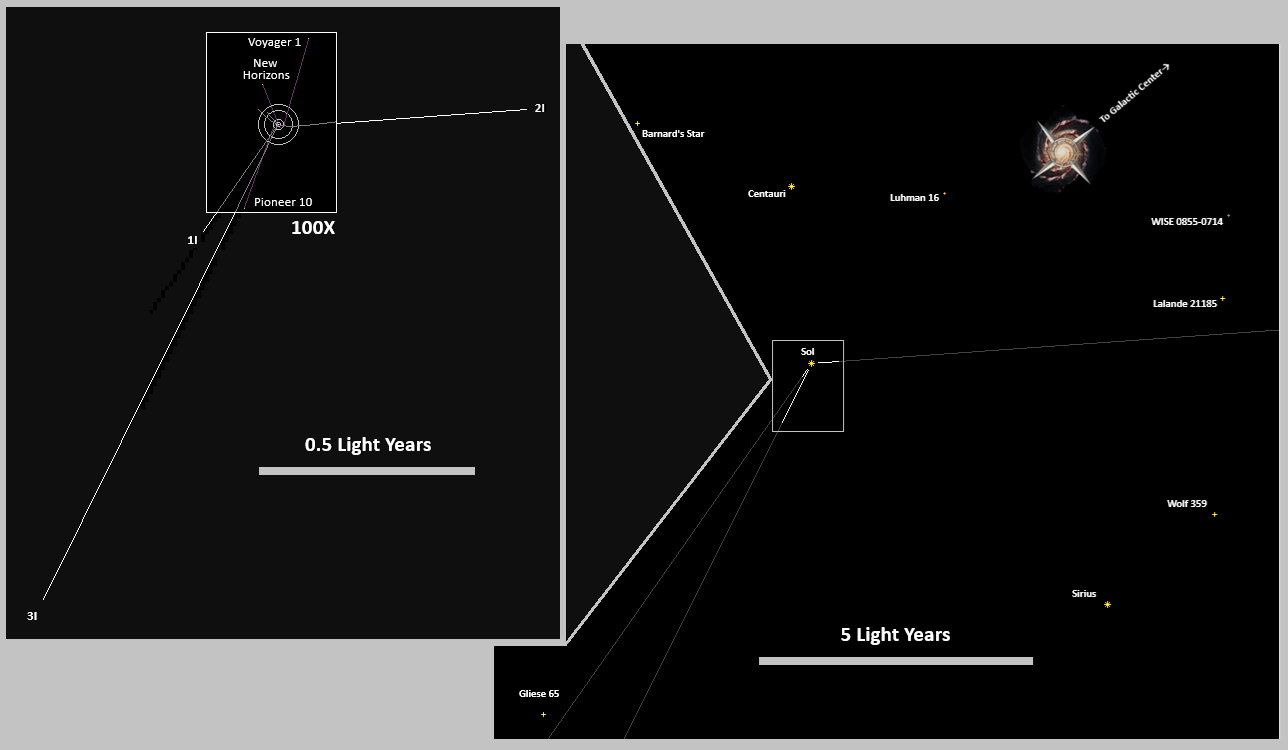
This infographic visualizes the kinematic challenge posed by interstellar comets to a recently-created cosmos. The main panel (5 ly scale) shows the nearest eight known stellar neighbors (yellow) and the trajectories of 1I/ʻOumuamua, 2I/Borisov, and 3I/ATLAS (grey lines). The white segments highlight the maximum distance each comet could have traveled in 6,029 years. Critically, these segments terminate far short of every known star, forcing the young-earth model to predict three undiscovered source bodies located precisely at the end of the white lines. The inset panel (0.5 ly scale) contains an additional inset zoomed in to 400X the main panel to show these source termination points relative to the outer solar system, where the trajectories of the planets and outgoing space probes are visible.