
He's Saying It Was Aliens ... But It Wasn't Aliens
Glenn Branch is deputy director of the National Center for Science Education, a nonprofit organization that defends the integrity of American science education against ideological interference. He is the author of numerous articles on evolution education and climate education, and obstacles to them, in such publications as Scientific American, American Educator, The American Biology Teacher, and the Annual Review of Genomics and Human Genetics, and the co-editor, with Eugenie C. Scott, of Not in Our Classrooms: Why Intelligent Design is Wrong for Our Schools (2006). He received the Evolution Education Award for 2020 from the National Association of Biology Teachers.
In the obituary published in The New York Times on January 16, 2026, Erich von Däniken was described, accurately, as “the best-selling Swiss author and self-styled maverick archaeologist who propagated the theory that thousands of years ago an advanced alien species visited Earth, mated with ancient humans and gave them the technology, and the intelligence, to erect such marvels as the Great Pyramids.” Unmentioned were his views on evolution, which is not surprising: although his massive oeuvre is punctuated by jabs at evolution, he appears to have written only one book focusing on the topic, Alles Evolution — oder was? Argumente für ein radikales Umdenken (Is It All Evolution — or What? Arguments for a Radical Rethink), published toward the end of his life, in 2020.
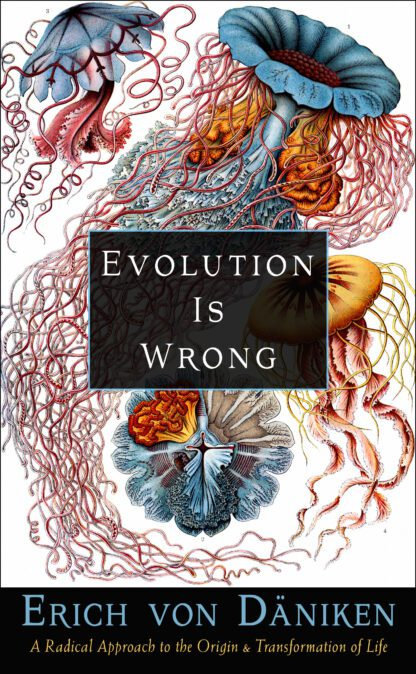
Evolution Is Wrong: A Radical Approach to the Origin & Transformation of Life, published in 2022, is apparently a translation of Alles Evolution — oder was?, although there is no clear indication of the original and no credit given to a translator. In a letter to his readers, von Däniken identifies his target: “Evolution is a fact and there isn’t the slightest doubt about it” (p. vii). Here “evolution” apparently means common ancestry of higher taxa, since he concedes, “Of course there is evolution with a small e,” offering the evolution of modern dogs “from a wolf-like primordial dog” by way of example (p. vii). “But,” he adds, “there are beings that live on our planet that, according to the evolutionary principle, should not exist” (p. vii). There is never any explanation of what “the evolutionary principle” is supposed to be.
Chapter 1, “Things Animals are Capable of,” occupies about half of the book. Von Däniken is impressed, as well he might be, by the adaptations of parasitic wasps, venomous spiders, migratory birds, and so on. (Despite the title, carnivorous plants and the myxomycete Physarum polycephalum appear at the end of the chapter.) A few pages are devoted to the bombardier beetle, a standby of creationist arguments, although none of the creationist literature is cited. So many adaptations are described that it would be tedious to check the accuracy of all of the descriptions, but there are blatant errors throughout. For a particularly shocking example, after he correctly explains that the electric eel is not a true eel, he adds, “Electric eels are actually marine fish” (p. 20). They are actually freshwater fish.
What is von Däniken hoping to accomplish here? On the one hand, at the start of his discussion of the bombardier beetle, he acknowledges, “Evolutionary biology has plausible explanations for the origins and behavior of innumerable kinds of species,” although he adds, “but definitely not for all” (p. 36). With over 1.5 million animal species described, it is hard to see why explaining the adaptations of every single species piecemeal is supposed to be a realistic task, much less what scientific value it would have. Rather, types of adaptation are what are going to be of interest to evolutionary biologists. The success of evolutionary biology in providing plausible evolutionary explanations of a wide variety of types of adaptations is a good reason to proceed on the assumption that it will continue to do so.
On the other hand, there are passages in which von Däniken seems to be suggesting that certain adaptations are in principle not explainable by the toolkit of evolutionary biology, e.g., “But half-lungs, quarter-wings, an unfinished penis, or just a twentieth part of a magnetic field that is perceived do not work” (p. 34). But he evidently lacks any clue about the contents of the toolkit. The phrase “natural selection” seems not to appear in the book (although it appears on the back cover). Rather, he writes as though he thinks that evolutionary explanations appeal to the mere passage of time, or to the beliefs and desires of animals, or the edicts of a capitalized Nature. There is no evidence in the text that he even attempted to understand the nature of explanations in evolutionary biology.
Either way, it is obscure what the relevance of the discussion of adaptations is to the book’s thesis — which, remember, is that evolution, in the sense of common ancestry of higher taxa, is wrong. Even if von Däniken were right that there is no plausible or possible evolutionary explanation of any of the adaptations that he discusses, how would that imply that the species he discusses have not descended with modification from a common ancestor? (In a few passages in chapter 1, he claims that various groups of organisms — termites and ants; anteaters and pangolins — are not related, but he may be speaking loosely, meaning that they are not as closely related as might be or once was assumed.) If he thinks that there is a connection here, he is woefully inept at communicating it.
In chapter 2 — given the typographically awkward title “Science! — Science?” — von Däniken turns his attention to the intellectual history of evolution. His discussion is chockablock with errors. For example: Diderot was not a clergyman; Darwin did not have a revelation about finches in the Galápagos; Darwin and Wallace were not present for the reading of their papers at the Linnean Society in 1858; the Communist Manifesto did not refer to Darwin; Nietzsche did not admire Darwin’s theory of evolution; Richard Dawkins was not Professor of Evolutionary Biology at Oxford University; William of Ockham did not write a book entitled The Principle of Simplicity; Phoebus Levene was not the discoverer of DNA; and the philosopher Thomas Nagel is not affiliated with the University of California, Berkeley.
In typical creationist fashion, von Däniken claims that evolution is accepted only because it is congenial to atheism, producing five quotations in evidence. Four, attributed to Ernest Kahane, Arthur Keith, Richard Lewontin, and the journalist Malcolm Muggeridge, are familiar and unpersuasive. The fifth, attributed to James Watson, is “The theory of evolution is a world-wide recognized theory, not because it can be proven, but because it is the only alternative to creation in which we do not want to believe” (p. 105). Oops. That should read “The theory of evolution [is] a theory universally accepted not because it can be proved by logically coherent evidence to be true but because the only alternative, special creation, is clearly incredible” and be attributed to a different Watson, D. M. S.
Not that von Däniken identifies himself as a creationist. Rather, he expresses sympathy with intelligent design, including not only its unconvincing disavowal of creationism but also its martyrological self-image: he imagines the scientific establishment crying, “Burn them at the stake!” (p. 125). But no sooner is the idea introduced than he begins to put his own characteristic alienocentric spin on it: “Someone or something — a spirit of the universe or aliens (?) — are behind this planning” (p. 125, parenthetical question mark in the original). A few pages later, he asks, “But how on earth should you imagine Intelligent Design? Who are these designers? What could their motives be? How did they go about it?” (p. 129) and then offers his own answers, albeit in the form of a story.
Recalling his previous admiring discussion of Fred Hoyle and Chandra Wickramasinghe’s panspermia, von Däniken imagines aliens who conclude that life on their planet originated in outer space. They then meet a different group of aliens — described oddly as toothless, perhaps to suggest their great age — who claim to have seeded life, and to have subsequently introduced new species of life, on their planet. The toothless aliens explain that “the Spirit of Creation provided the first life” (p. 134); in disseminating life throughout the universe, they take themselves to be fulfilling the intention of the Spirit of Creation. Though in general uninformative, the story at least suggests that von Däniken favors a form of progressive creationism, with aliens replacing a supernatural creator except at the origin of life.
Chapter 3, “Hushed Up and Suppressed,” discusses what von Däniken alleges to be the hidden evidence that challenges the conventional account of human evolution, with plenty of citations to von Däniken’s own previous writings, Michael Cremo and Richard Thompson’s Forbidden Archaeology (1993), which promotes a form of creationism based on Hindu scripture, and Ellis Silver’s bizarre Humans Are Not from Earth (2007). The claims are typically presented without convincing, or even plausible, evidence. A novelty is the claim that Robert Martin, a biological anthropologist at the Field Museum, “is convinced that humans and dinosaurs lived at the same time” (p. 150), which is instantly belied by a quotation describing him as holding that primates — not humans as such — originated about 90 million years ago.
Particularly egregious is von Däniken’s claim that a 2004 study comparing chimpanzee chromosome 22 with its counterpart human chromosome 21 found that “the amino acid sequence of the 231 proteins discovered in humans and apes differs by 83 percent” (p. 166). He proceeds to complain that the finding is scientifically ignored. But according to its abstract, the study actually found that “83% of the 231 coding sequences, including functionally important genes, show differences at the amino acid sequence level.” Evidently von Däniken confused the number of the differences with the size of the differences. It is as though he read “83 percent of male elephants are heavier than the average female elephant” and wrote, “The average weights of male and female elephants differ by 83 percent.”
Besides rehearsing these supposed challenges to human evolution, von Däniken reiterates his preferred explanation: “[T]here have always been artificial mutations, targeted external interventions, throughout the history of mankind” (p. 166). Since he already conceded that evolutionary explanations for changes within a species are often plausible, it is obscure why he thinks that they fail in the case of humans. Nevertheless, he continues, “Since our Stone Age ancestors definitely neither did genetic research nor were able to change the genetic code, only extraterrestrials remained as an explanation — exactly what today is described as Intelligent Design” (p. 166). Amusingly, he complains that only a few of today’s proponents of intelligent design have the courage to acknowledge the original source of their ideas.
Chapter 4 asks “Where Are the Fossils?” Claiming that the world should be teeming with fossils showing the evolution of humans, von Däniken asks, “Why did their bones vanish into thin air?” and immediately answers, “Not into air, but into water” (p. 176). Yes, he proposes to explain the incompleteness of the human fossil record by invoking the Flood. He quotes the story of Noah from the Bible, over the space of four pages, and follows it with parallel stories from Chaldean and Babylonian mythology. The Flood was real, global, and the work of extraterrestrials seeking “to allow a new gene pool to grow,” he concludes (p. 190). Having induced a narrow genetic bottleneck, the extraterrestrials moreover modified the DNA of the survivors. “We humans of the twenty-first century are [their] descendants” (p. 190).
He’s saying that it was aliens, to invert the meme. Von Däniken apparently thinks that extraterrestrials intervened in the evolutionary process on Earth by culling gene pools (chapter 4), conducting genetic engineering on humans and their ancestors (chapters 4 and 3), perhaps seeding the first life on Earth (chapter 2), and possibly importing extraterrestrial organisms unrelated to earthly biota to Earth (chapter 2). It is perhaps not absurd to suppose that he also thinks that they arranged for the adaptations that he takes evolutionary biology to have difficulty explaining (chapter 1), although it seems like a lot to ask of the already overworked aliens. But, of course, it wasn’t aliens. There is no evidence of such extraterrestrials and no need to posit their activity, von Däniken’s whole output notwithstanding.
Unsurprisingly, Evolution Is Wrong abounds in blatant errors, unsupported claims, and crazy assertions, too many to be itemized, let alone debunked, in the course of a brief treatment. But perhaps the most annoying feature of the book, typical of von Däniken’s writing in general, is the tendency to resort to a rhetorical question — the last sentence of the book is “Is that understood?” (p. 193) — or, worse, a string of rhetorical questions. What is the appeal of doing so? Is von Däniken simply trying to guide his readers to construct their own understanding? Or is he seeking to advance his views cryptically, without having to assume any responsibility for holding them? Or is he simply unwilling or unable to articulate a plausible line of reasoning when needed? Who can say?
Acknowledgements
Thanks to John Harshman for reading a draft and to Nicholas Wagner for noticing von Däniken’s error about the habitat of the electric eel.