
Araneus diadematus
Photography Contest.
Gert Korthof, Winner.
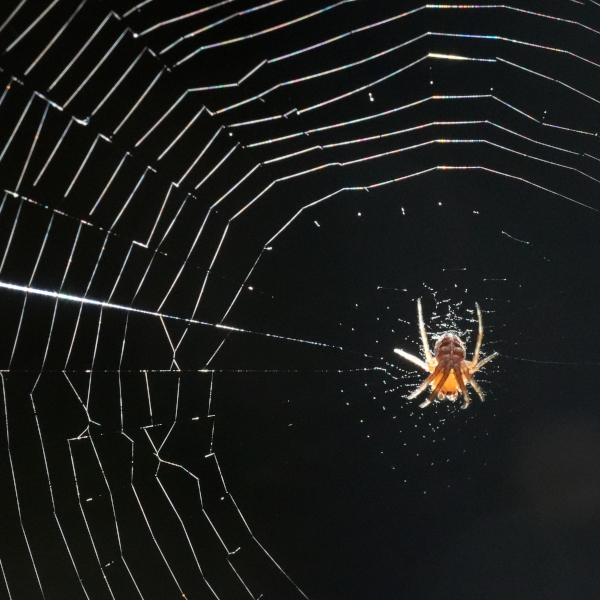
The remaining two photographs:
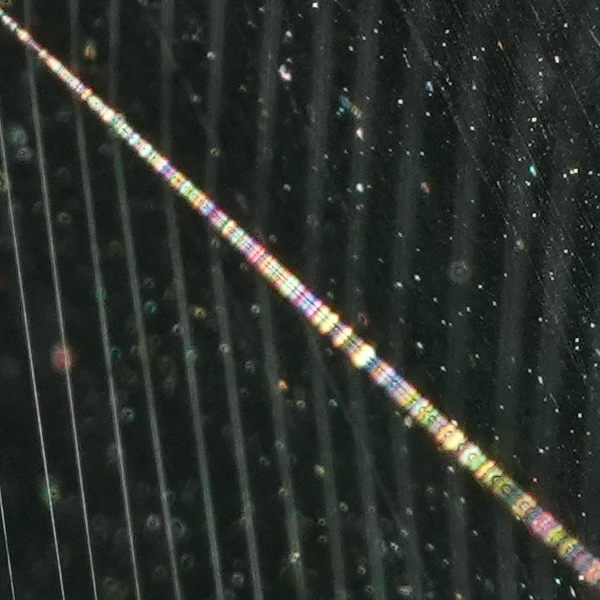
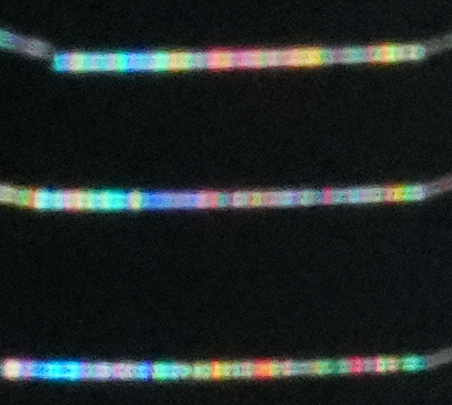
And the remainder of the commentary:
In macro photographs of single threads of the web, many differently colored, sharply defined transverse bands are revealed. Are they real or just optical illusions? If they are illusions, why do we see an almost endless row of transverse bands instead of a continuous light spectrum like a rainbow? It is hard to believe that sunlight can produce these in a homogeneous fiber. Instead it seems more reasonable to assume that fine-meshed transverse bands do exist along the length of the thread and have different structural biochemical properties. Because these threads are of biological origin, I expect that these bands or stripes can be explained by different protein contents (spidroins). In short: I think the cross-transverse bands are real and not optical illusions, although the exact colors are caused by optical effects and depend on the direction of the light rays.
I shall add that the web was most likely backlighted, rather than, as I had initially assumed, frontlighted, like a rainbow. I had initially thought that the color was due to dispersion, but possibly it is diffractive. Dietrich Zawischa gives a general, qualitative explanation here. See also here.