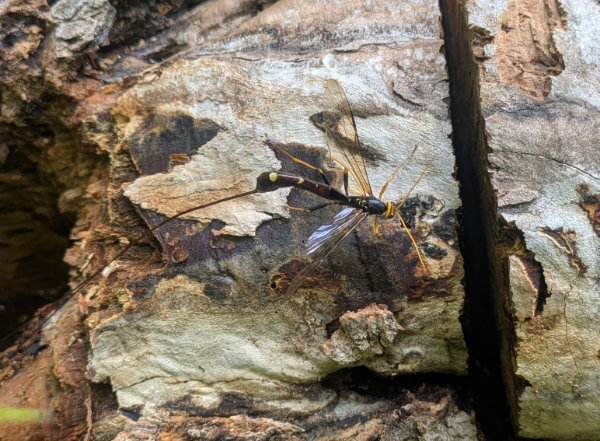
Megarhyssa greenei and M. atrata
Photography Contest.
Malcolm Schongalla, Honorable Mention.
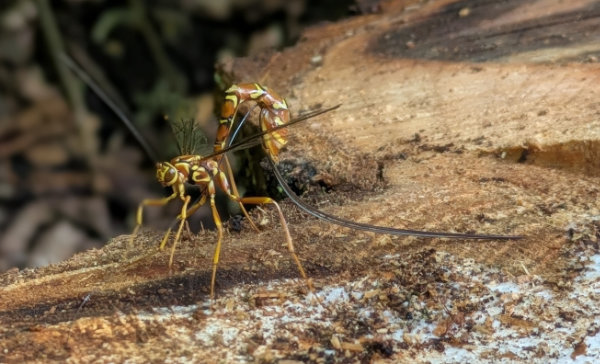
More, including the second photograph, below the fold.
He continues, “In Charles Darwin’s 1860 letter to Asa Gray, he wrote:
"I had no intention to write atheistically. But I own that I cannot see, as plainly as others do, & as I shd wish to do, evidence of design & beneficence on all sides of us. There seems to me too much misery in the world. I cannot persuade myself that a beneficent & omnipotent God would have designedly created the Ichneumonidæ with the express intention of their feeding within the living bodies of caterpillars, or that a cat should play with mice. Not believing this, I see no necessity in the belief that the eye was expressly designed. On the other hand I cannot anyhow be contented to view this wonderful universe & especially the nature of man, & to conclude that everything is the result of brute force. I am inclined to look at everything as resulting from designed laws, with the details, whether good or bad, left to the working out of what we may call chance. Not that this notion at all satisfies me. I feel most deeply that the whole subject is too profound for the human intellect. [1]
"1. Darwin, Charles. Darwin Correspondence Project, 'Letter no. 2814,' accessed on 17 June 2026, https://www.darwinproject.ac.uk/letter/?docId=letters/DCP-LETT-2814.xml."