
Jared Diamond: What if Darwin had died in childbirth?

I recently listened to Jared Diamond interviewed on an episode of The Michael Shermer Show: How Much Can One Person Change History? Diamond is probably best known for his book Guns, Germs, and Steel, which I had read when it came out. His newest book, published this fall, is Profits, Prophets, Coaches, and Kings: (When) Do Leaders Matter? The content of the book is well summarized in the Shermer Show and also reflected accurately in the titles. That said, when someone as bright as Diamond wonders about Darwin, I have to take notice, so I picked up the book and read it, followed by three reviews, in the Times, the Guardian, and the Globe and Mail. The Globe and Mail article was favorable, the Guardian article mixed, and the Times article properly critical but sometimes perhaps a bit catty.
Before we get to Darwin, let us back up a little bit and discuss what Diamond calls the Hamlet test.
Early on in the book, Diamond proposes the Hamlet test as a means to decide whether some historical event could have taken place without a specific individual. He concludes that to write a play in Elizabethan England, you had to have a connection with a theater company. Very few people (Marlowe? Jonson?) had such connections, and Diamond thinks that those other than Shakespeare were not up to writing a play as good as Hamlet. Marlowe’s and Jonson’s plays are rarely performed today; I have read Tamburlaine but never seen a play by either Marlowe or Jonson. Hence, the Hamlet test: Remove Shakespeare, and no Hamlet. Thus, Diamond asks, if you remove a person from history, would history be different? Apply the Hamlet test and find out. (The Guardian’s reviewer, Stephen Poole, notes a devil in the detail that Marlowe was killed at the age of 29, or 10 years younger than Shakespeare was when he wrote Hamlet. Maybe in 10 years Marlowe would have been capable of writing a play as great as Hamlet.)
Darwin at last: Michael Shermer asks about Darwin at approximately the 38-min mark in the interview. Citing Frank Sulloway, he notes that Darwin was already investigating a voyage to the Canary Islands when he agreed to travel on the Beagle. Evolution was in the air, but (to use Pasteur’s phrase) Darwin had the only prepared mind. Diamond claims that
the breakthrough began with Charles Darwin's 1859 book On the Origin of Species by Means of Natural Selection. That book amassed half a dozen lines of overwhelming evidence for evolution, based on fossils, biogeography, geographic variation, anatomy, embryology, taxonomy and domestication. Darwin thereby ‘jump-started’ the conversion of biologists, and of much of the broad public, to accept evolution as a fact, and natural selection's role as a driving force.
Diamond goes on to anticipate your objections by claiming that Darwin “stood out” by stressing natural selection and unlike Alfred Russel Wallace recognized the role of sexual selection. “Hence I think,” says Diamond, “that a world without Darwin might have been a different world, albeit still a world accepting evolution as a fact.”
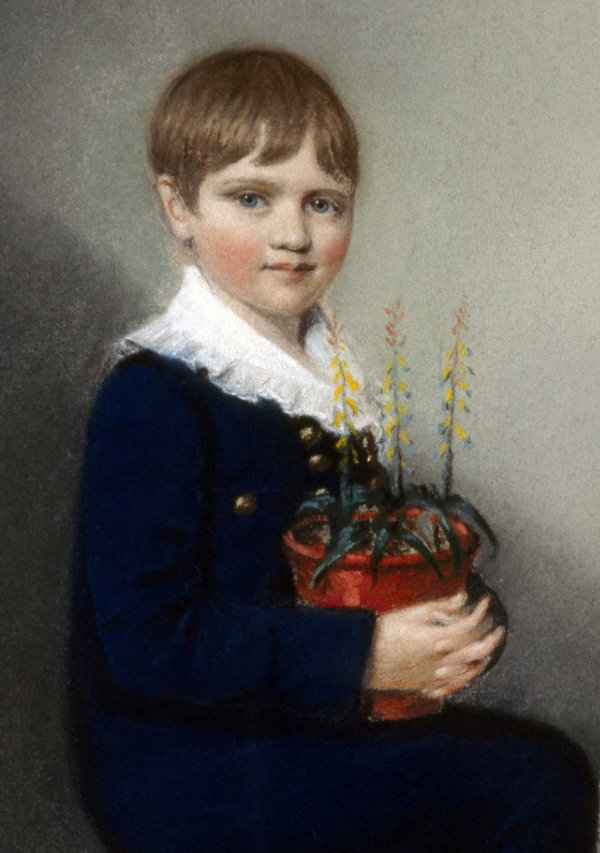
That conclusion seems fairly weak. Without Darwin, we would not have been deprived of a theory of natural selection; Wallace would have provided it (if not Patrick Matthew, though that is a longshot). Would scientific progress in and public acceptance of evolution have slowed and by how much, if Darwin had died of smallpox at age 6? What would evolutionary biology be like today? What other scientists actually changed the history of science? What do readers think?
Just for the record, I have singled out Diamond’s examination of Darwin’s contribution, which appears in an Epilogue. There is much more to the book than the Hamlet test. I am not expert enough to know whether his overall approach is defensible. Sometimes his conclusion is an unequivocal maybe.
And finally, sort of an appendix: Diamond convinces me that absolutely nothing would have changed if Gregor Mendel had not performed his experiments on peas. Mendel’s work was discovered only after several later botanists had independently performed similar experiments. Diamond wonders why no one besides Mendel had thought of such simple experiments and notes that “breakthroughs in science also require efforts by leaders to disseminate their discoveries.” I was underwhelmed, at best.