
Was I wrong about fitness surfaces? Reply to reply to reply to Dembski
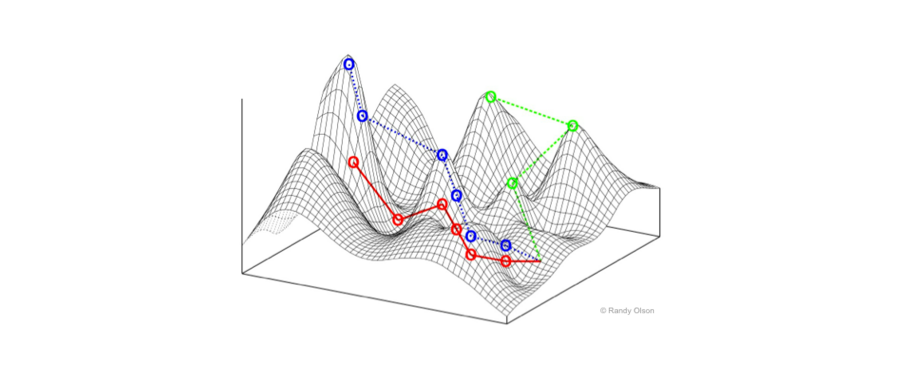
By Randy Olson - Own work, CC BY-SA 3.0, Link
Not too long ago I became aware that William Dembski had a new article (here) in the BIO-Complexity (the Discovery Institute’s house journal). And that a section of that article disputed my statements about smooth fitness landscapes (or fitness surfaces).
He is replying to a post by me here at Panda’s Thumb on 6 February 2025 (here). He and Robert Marks (and also Winston Ewert) had argued that there was a Conservation of Information law, that showed that when information gets into genomes, it must have already existed elsewhere. They said that this was even true when natural evolutionary processes put adaptive information into the genome – it must have already existed, for example, in the fitness landscape.
Their argument (which can be seen here and here) uses the concept of “active information”. For situations in which there is a population evolving on a fitness landscape, active information can include the information embodied in the assignment of fitnesses to genotypes.
Dembski, in his BIO-Complexity paper, summarizes my arguments thusly:
- Real-life biological evolution requires smooth fitness landscapes.
- Physics and chemistry guarantee that real-life fitness landscapes are smooth.
- Any probability estimates of smooth fitness landscapes among the totality of fitness landscapes are therefore irrelevant.
- No-free-lunch theorems hold for the totality of fitness landscapes, both smooth and non-smooth.
- No-free-lunch theorems therefore do not apply to real-life biological evolution.
- Conservation of information is equivalent to no freelunch, so conservation of information is likewise irrelevant to real-life biological evolution.
He argues that there are exceptions to all fitness landscapes being smooth, that I have conflated the No Free Lunch argument with his Conservation of Information argument, and that the latter is his essential argument.
Let’s look at his refutation in some detail:
We’ll consider a simple case of evolution. A case where we have a set of genotypes, and each possible one has a fitness. Where there is a simple form of mutation which changes a genotype by substituting one base for another at one of the sites of the genotype. The mapping between genotype and fitness is the fitness landscape.
Dembski’s 2002 argument
If we go back to his 2002 book, Dembski poses tne question of whether “algorithms” such as natural selection can explain the origin of Complex Specified information. He argues (on page 149) that
Algorithms and natural laws are in principle incapable of explaining the origin of CSI. To be sure, algorithms and natural laws can explain the flow of CSI. Indeed, algorithms and natural laws are ideal for transmitting already existing CSI.
Taking that position, in the case of a fitness landscape, if natural selection and other evolutionary processes achieve an increase in fitness great enough to be counted as Complex Specified Information, that information must be already existing in the form of the fitness landscape (or as he called them in 2002, fitness functions).
Dembski concludes (p. 195), for the case of an evolutionary algorithm, that it
has borrowed specified complexity
from a higher-order phase space, namely, the phase space of fitness functions.
Where No Free Lunch comes in
For all possible genotypes (say 3 billion bases in a hapoid genome, with each base being one of A, C, G or T) the fitness is a nonnegative real number. The set of all possible combinations of fitnesses is a very big space, and that does not even consider variation in the length of the genome.
To consider how much specified information comes from the particular fitness landscape, we need to know the probabilities of all possible combinations of fitnesses. That is a very big space.
A much smaller and simpler space is the one considered by Wolpert and Macready in their No Free Lunch theorem (here). They consider one assignment of fitnesses to all of the possible sequences, and then permute those assignments in all possible ways. Their No Free Lunch theorem shows that, averaged over all of these assignments, when they were weighted equally and the search algorithm looked at K genotypes in all, the success of search for higher fitnesses would be no better than choosing the best out of arandomly chosen K genotypes.
This means that when the search algorithm found success by moving one step in a particular direction, an algorithm that continues to move further that direction would not help with further gains. When the fitness landscape is equally likely to see any permutation of fitnesses, there is no way to choose any good direction to move.
Strong and unpredictable interactions between sites
In the No Free Lunch case, there are also typically very strong and unpredictable interactions between sites. If we have two different sites in the genome, and find a favorable substitution at each of them, what happens when both of these substitutions have occurred? The combination of them is yet another haploid genome, so that there is no way to predict what the fitness will be when both changes have occurred.
Is the No Free Lunch case the worst case for evolution?
The point of invoking the No Free Lunch theorem is to show a situation in which evolutionary change will do not better than a search that looked at the same number of genotypes, but which are picked at random from all possible genotypes. Is that case one in which no progress is made? No, some progress will be made. By natural selection finding the highest fitness among K genotypes, we actually do put some functional information into the organism’s genome even in the NFL case.
Stewart Kauffman and Simon Levin (here) have done computer simulations on similar cases in genomes that have 0s and 1s instead of four bases. There can be considerable progress, even in their NFL cases.
A worse case would be if the nest step were simply to a genotype randomly selected from those looked at; a case where there was no natural selection.
How smoothness of the fitness landscape helps
We get even more functional information if we have a relatively smooth fitness landscape. In that case after each step, there is quite often a chance for further progress on the next step. The hazard is getting stuck on a local optimum, forever. With an NFL landscape one gets stuck on a local peak rather quickly; on a fairly smooth landscape one can keep climbing for many steps.
An important point is that even in very rough fitness landscapes, natural selection can make some progress. Even if we are not on a smooth surface. So a predisposition to having a smooth surface is not the only reason for progress.
Is intelligence required?
In William Dembski’s 2002 book “No Free Lunch: Why Specified Complexity Cannot Be Purchased Without Intelligence”, he argues that any evolution of specified complexity is due to choice of a special fitness landscape out of the set of all possible fitness landscapes:
The upshot of these theorems is that averaged over all possible fitness functions, no search procedure outperforms any other. It follows that any success an evolutionary algorithm has in outputting specified complexity must ultimately be referred to the fitness function that the evolutionary algorithm employs in conducting its search. The No Free Lunch theorems dash any hope of generating specialized complexity via evolutionary algorithms. (p. 196)
He identifies the source of the specified complexity as intelligence:
The No Free Lunch theorems show that for evolutionary algorithms to output CSI they first had to receive a prior input of CSI. And since CSI is reliably linked to intelligence, evolutionary algorithms, insofar as they output CSI, do so on account of a guiding intelligence. (p. 223)
Is there a predisposition to smoothness in real fitness functions?
There is. The easiest way to see this is to consider the effect on fitness of a single base change. This can be bad, or even lethal, but in a great many cases it will only reduce the fitness moderately.
Compare that to the effect of a single base substitution in the No Free Lunch world. A single base substitution carries the genotype to the fitness of a randomly chosen other genotype. A randomly chosen genotype differs from the previous one at about 3/4 of all sites. In humans that would be one that differs from the previous genotype in 2,225,000,000 bases.
If we were near the NFL type of fitness landscape, the average effect of a single base mutation would be similar to the effect of over 2 billion simultaneous mutations. With a single base change, We obviously aren’t anywhere near that. Mutations can be lethal, a fraction of the time. But 2 billion mutations will essentially always be lethal. The difference between these shows that fitness landscapes are mostly much smoother than NFL landscapes.
What did I say about physics and fitness landscapes?
Dembski’s criticizes me arguments about smoothness of fitness landscapes thusly:
Most fitness landscapes would thus be like hash functions in cryptography (Felsenstein describes them as “white noise fitness surfaces”) where the slightest change in an input completely alters the numerical output [42]. Now Felsenstein’s point is that such jagged fitness landscapes, as allowed by no-free-lunch theorems, violate biological reality. The fitness landscapes conducive to evolvability, such as might characterize how genotypes promote reproductive success, must, according to him, be smooth. Why? Because of physics. Thus he remarks:
[I]t seems reasonable that physics itself predisposes fitness surfaces to be smooth. After all, the forces of physics tend to be local in time and space and to lose influence with greater distance. If I gesture with my fingers, there is hardly any effect on objects at a distance. The floor of our room does not collapse, nor does the ceiling cave in. Different objects are scarcely affected by each other.
The problems with this reasoning are numerous. In the first place, physics does have a place for precipitous and even nonlocal effects. Quantum entanglement is instantaneous and unaffected by distance. Phase transitions in nonlinear dynamics may produce radical changes in the behavior of a system with but the slightest change in a parameter. Felsenstein’s argument is based on folk physics, not modern physics and as such is unconvincing.
Did I say that all fitness landscapes in biology are completely smooth? No. But Dembski’s refutation cites the mere existence of “precipitous” effects in physics as if I had made a statement about all such effects, without exception. Fitness landscapes tend to be smooth, that’s all. Enough to allow natural selection to often make progress. And not always. Ask the ammonites, the pelycosaurs, the seed ferns.
A strawman, but no refutation
Dembski’s reply is a strawman, or rather a straw-fitness-landscape. It would be relevant if I had argued that all fitness landscapes are pleasantly smooth. I am not refuted.
No Free Lunch versus conservation of information
There is also the matter of whether Dembski did or did not use the NFL theorem to argue against the ability of natural selection to put specified information into genomes. His 2025 BIO_Complexity paper says
By themselves, the no-free-lunch theorems do not refute Darwinism, nor have I ever claimed that they do. Yes, I wrote a book titled No Free Lunch (pub lished in 2002) that used the no-free-lunch theorems as a springboard to critically re-examine the power of the Darwinian mechanism in explaining biological complexity and from there to argue that design is a better explanation of biological complexity. Yet Darwinian critics of conservation of information have ever since conflated conservation of information with no free lunch,
We have seen, above, his statements from the 2002 book. In that book, he argued from a Law of Conservation of Complex Specified Information. Lately he has been arguing that the law that counts is not No Free Lunch, but the Law of Conservation of Information. Yet in his recent second edition of The Design Inference, with Winston Ewert as co-author, he presents an extended argument, defining Algorithmically Specified Complexity, in a somewhat detailed argument.
Yet there are two parts of the argument completely missing in that book:
- They do not explain why adaptations that increase fitness must have a simple description.
- They do not explain why, if adaptations did require a short description, natural selection could not bring that about.
I short, their book of over 700 pages leaves their supposedly-essential conservation of information argument unable to connect to adaptation by natural selection.
It would be nice to have them make this connection, because then we could evaluate their current not-the-same-as-No-Free-Lunch conservation-of-information argument against the ability of natural selection to incorporate specified information into a genome. It is currently missing. Or does it simply not exist?